How Capacity Segmentation Drives Growth in the Europe Recycling Equipment Market: Small, Medium, and Large-Scale Perspectives
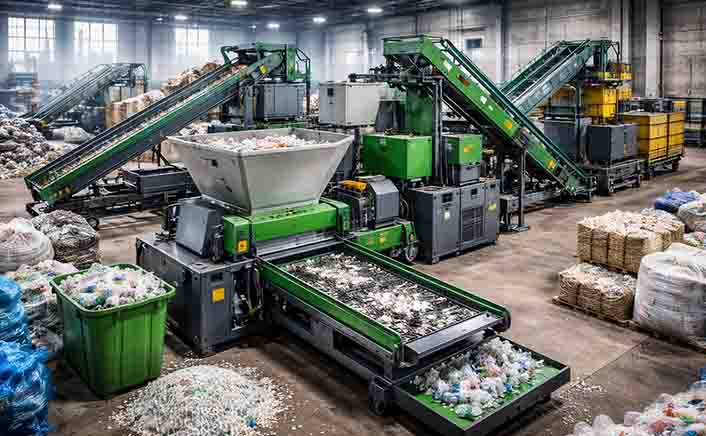
The Europe Recycling Equipment Market presents a diverse distribution across various capacity segments, catering to the distinct needs of municipal, industrial, and commercial recycling operations across the region. Generally, capacity classification is divided into three categories: small-scale equipment processing less than 10 tons per hour, medium-scale equipment handling between 10 and 50 tons per hour, and large-scale equipment exceeding 50 tons per hour. Each of these segments addresses specific operational requirements, available infrastructure, and investment capabilities, which collectively shape the overall market structure and growth trends.
Small-scale equipment, which constitutes approximately 22% of the market, is frequently utilized in community-based recycling facilities, niche industrial applications, and pilot projects that demand flexible and cost-effective solutions. Such systems are particularly favored in municipalities with limited waste throughput or in remote areas where large-scale alternatives are impractical. Despite their lower capacity, small-scale units play a significant role in regional sustainability efforts by enabling localized processing and minimizing transportation costs and the carbon footprint associated with transferring waste to central facilities.
Medium-scale equipment dominates the Europe recycling equipment market, comprising an estimated 48% of total market share. This segment has gained extensive adoption thanks to its optimal balance between investment costs, processing capacity, and operational efficiency. Medium-scale units are commonly found in municipal material recovery facilities (MRFs), industrial recycling plants, and commercial recycling hubs. Typically integrating a mix of shredders, granulators, sorters, and balers, these systems facilitate multi-material processing, which encompasses plastics, metals, paper, and e-waste. The adaptability of medium-scale equipment allows operators to modify processing volumes in response to seasonal waste fluctuations, government-mandated recycling targets, and corporate sustainability goals. Furthermore, this segment benefits from growing automation and smart technology integration, including AI-based sorting systems and IoT-enabled monitoring, which enhance efficiency and material recovery rates. As European nations continue to invest in recycling infrastructure in line with circular economy initiatives, medium-scale installations remain a central focus for both public and private sector investments.
Large-scale equipment accounts for approximately 30% of the Europe recycling equipment market and is predominantly used in high-capacity industrial recycling operations, including advanced MRFs, plastics reprocessing facilities, and e-waste recycling centers. These systems are known for their high throughput, sophisticated automation, and capability to manage complex waste streams. Large-scale installations are strategically significant in countries with high population densities and considerable industrial activity, such as Germany, France, and the United Kingdom, where waste volumes demand centralized, high-efficiency recycling solutions. Investment in large-scale equipment often receives support from government incentives, public-private partnerships, and sustainability mandates, which encourage the establishment of state-of-the-art recycling facilities. Additionally, large-scale systems contribute significantly to economies of scale, reducing per-unit processing costs and enhancing overall operational efficiency. The trend toward modular, high-capacity systems allows operators to increase throughput without the need to completely replace existing equipment, ensuring long-term scalability and adaptability in response to changing waste composition and regulatory requirements.
Throughout all capacity segments, the Europe recycling equipment market is profoundly impacted by technological advancements, regulatory policies, and sustainability imperatives. The demand for energy-efficient, AI-integrated, and environmentally compliant equipment is rising across small, medium, and large-scale systems. As Europe bolsters its circular economy framework, the need for versatile and high-performing recycling equipment becomes increasingly urgent, ensuring that all capacity categories remain relevant. Small-scale units facilitate localized, flexible recycling solutions; medium-scale systems meet the mainstream municipal and industrial requirements; while large-scale equipment forms the backbone of the region’s advanced recycling infrastructure. This structured capacity segmentation allows the market to address diverse operational needs while supporting broader environmental and economic objectives, ultimately reinforcing Europe’s position as a global leader in recycling technology and infrastructure.