U.S. Mass Timber Construction Market to Reach USD 1.09 Billion by 2033 as Low-Carbon Building Materials Gain Commercial Momentum
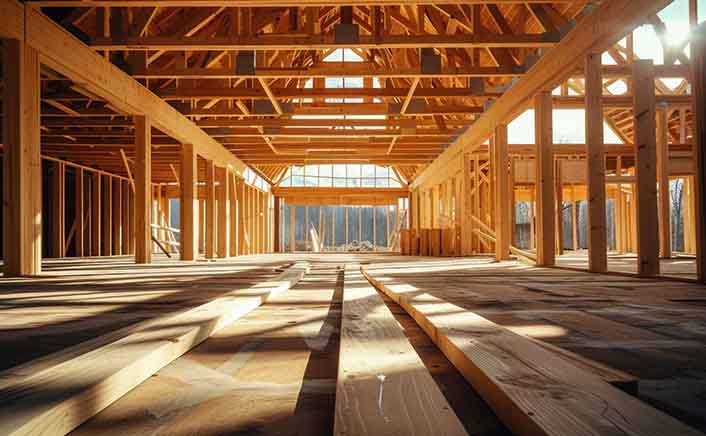
The U.S. Mass Timber Construction Market is projected to grow from USD 0.39 billion in 2025 to USD 1.09 billion by 2033, registering a CAGR of 13.1% during the forecast period. The market is benefiting from rising adoption of low-carbon construction materials, modernization of U.S. building codes, and increasing commercial deployment of engineered wood systems across institutional and mixed-use developments.
Mass timber refers to engineered structural wood products such as Cross-Laminated Timber (CLT), Glue-Laminated Timber (Glulam), Nail-Laminated Timber (NLT), and Laminated Veneer Lumber (LVL), which are increasingly being used as alternatives to steel and concrete in mid-rise and high-rise construction projects. Unlike traditional wood framing, mass timber systems are prefabricated structural assemblies designed to support larger commercial and institutional buildings while reducing embodied carbon emissions.
The U.S. construction sector is experiencing mounting pressure to decarbonize amid stricter environmental targets and growing investor focus on sustainable infrastructure. According to the United Nations Environment Program, buildings and construction account for nearly 37% of global energy-related carbon emissions, intensifying demand for alternative structural materials with lower lifecycle emissions. Mass timber has emerged as a commercially viable solution because engineered wood systems can significantly reduce embodied carbon while improving construction efficiency.
A major catalyst for market expansion has been the revision of the 2021 International Building Code (IBC), which permits mass timber buildings up to 18 stories under specific construction classifications. The updated code framework has accelerated adoption among developers, architects, and public infrastructure agencies seeking sustainable alternatives for commercial and institutional projects.
Several landmark developments have strengthened confidence in the structural viability of mass timber systems. The Ascent tower in Milwaukee, one of the tallest timber buildings in the world, demonstrated the feasibility of large-scale timber construction in urban environments. Technology companies and institutional developers are also increasingly incorporating engineered timber into campus expansions and mixed-use projects to align with ESG commitments and carbon reduction goals.
Commercial and institutional applications currently account for the largest share of market demand. Universities, civic infrastructure agencies, and real estate developers are among the leading adopters, driven by the combination of sustainability benefits, faster construction timelines, and prefabrication efficiency. Prefabricated CLT and Glulam systems can reduce on-site labor requirements and shorten project schedules by several weeks compared to conventional concrete structures, an important advantage amid ongoing labor shortages in the U.S. construction sector.
Cross-Laminated Timber (CLT) remains the dominant product segment due to its high structural strength, dimensional stability, and compatibility with modular construction systems. Advances in CNC manufacturing and Building Information Modeling (BIM) integration are also improving fabrication precision and project coordination, further enhancing adoption across complex commercial projects.
Regional growth remains strongest in the western United States, supported by forestry resources, progressive building regulations, and aggressive embodied carbon reduction initiatives in states such as California, Oregon, and Washington. However, the southeastern U.S. is emerging as an important future growth hub due to abundant timber supply and increasing investments in domestic manufacturing capacity.
Despite strong momentum, the market continues to face challenges, including higher upfront costs, limited contractor expertise, and fragmented supply chains. Insurance and financing complexities also remain barriers for some developers, given limited historical performance benchmarks for large-scale timber assets. However, continued investments in domestic CLT production facilities and growing institutional familiarity with engineered timber systems are expected to improve market scalability over the coming decade.
Leading companies operating in the U.S. Mass Timber Construction Market include SmartLam North America, Mercer Mass Timber, StructureCraft, KLH Mass Timber, and Swinerton. Market participants are focusing on manufacturing expansion, vertically integrated fabrication capabilities, and strategic partnerships with architects and developers to strengthen their position in the evolving low-carbon construction ecosystem.