Clear infrastructure targets, oil-and-gas-backed deployment, and structured public rollout programs are positioning the UAE as the Middle East’s most institutionally advanced hub for EV charging infrastructure.
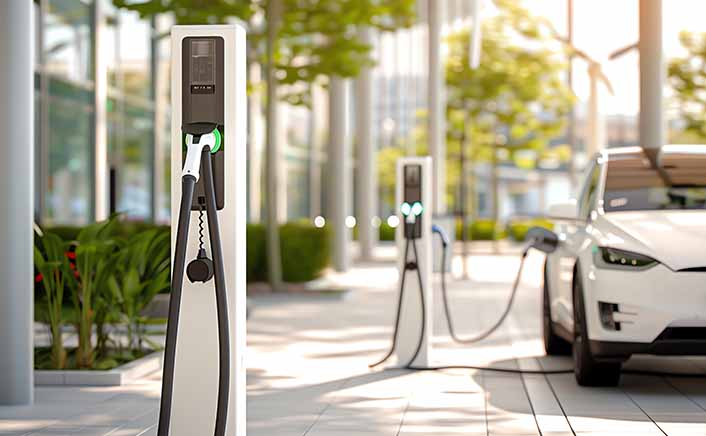
The UAE is accelerating its transition from initial EV charging efforts to a comprehensive nationwide network as part of its broader Net Zero 2050 and clean mobility goals. By 2024, more than 620 public charging stations will be operational, with the Dubai Electricity and Water Authority (DEWA) operating 382 EV Green Chargers and aiming for 1,000 by 2025. Abu Dhabi plans to add 1,000 more chargers across 400 locations. Meanwhile, ADNOC Distribution’s joint venture E2GO intends to deploy up to 70,000 charging points by 2030. The UAE EV Charging Infrastructure Market was valued at USD 0.40 billion in 2025 and is forecast to grow to USD 1.22 billion by 2033, with a CAGR of 15.0% from 2027 to 2033. This growth is driven by policy support, increasing EV adoption, and institutional investment.
The announced infrastructure commitments mark a significant turning point for the market. Abu Dhabi’s plan to deploy 1,000 charging stations significantly boosts charger density beyond pilot projects, and the long-term goal of 70,000 charging points under E2GO fundamentally shifts supply expectations. Unlike many emerging EV markets driven by private operators, the UAE approach is led by utilities and national energy companies, which helps reduce financing risks and speeds up implementation.
DC fast charging currently generates a large portion of infrastructure revenue because of its higher capital costs and deployment along corridors. Although AC charging continues to dominate volume, especially in residential and workplace settings, the growth of ultra-fast chargers in busy urban areas highlights the UAE’s approach to viewing charging as a premium mobility service rather than just a compliance obligation. Over time, the revenue structure is anticipated to evolve, with more income coming from software integration, load management systems, and operations and maintenance as the installed base grows.
Demand fundamentals are strengthening alongside infrastructure expansion. Dubai’s EV market share in new vehicle sales is nearing double digits, indicating a shift beyond early adopters. Fleet electrification is gaining traction in logistics, ride-hailing, and government transportation sectors, forming a secondary growth layer. As charging infrastructure improves and range anxiety diminishes, adoption is expected to become more responsive, reinforcing the positive cycle between infrastructure and vehicle growth.
Export dynamics play a smaller role in physical charging infrastructure compared to energy markets. However, the UAE’s role as a regional EV hub provides indirect strategic advantages. Thanks to advanced port logistics, reliable grid infrastructure, and integrated urban planning, the country is increasingly seen as a model for large-scale deployment of EV ecosystems across the GCC.
Cost competitiveness remains a key structural factor. DC and ultra-fast chargers demand substantial grid upgrades and higher initial costs, with prices between USD 45,000 and USD 75,000 per unit. Nonetheless, the UAE's centralized planning, robust sovereign finances, political stability, and unified regulatory frameworks help mitigate these capital challenges. As a result, deployment tends to be quicker compared to more fragmented private-sector markets.
Competitive Landscape
The UAE's EV charging ecosystem is driven by coordinated efforts among utilities, oil and gas firms, technology OEMs, and mobility service providers. Major players include ABB Ltd., Siemens AG, Schneider Electric SE, Tesla Inc., ADNOC Distribution, E2GO, Dubai Electricity and Water Authority (DEWA), Emirates Water and Electricity Company (EWEC), ChargePoint Holdings Inc., and Al-Futtaim Electric Mobility Company. Recent focus has been on expanding deployment, fostering public-private partnerships, and integrating charging networks into smart-grid systems, rather than competing on pricing.
The UAE EV Charging Infrastructure Market competition centers on deployment speed, reliable technology, grid integration, and long-term service revenue. As electrification efforts intensify and EV adoption increases across both the passenger and fleet sectors, the UAE’s early institutional coordination, ambitious infrastructure goals, and oil-and-gas investment backing are expected to support steady, policy-driven growth through 2033.