How Commercial Rice Mills Are Driving Large Scale Growth in the Rice Milling Machine Market Across Global Processing Industries
The Rice Milling Machine Market showcases a diverse structure of end users, with commercial rice mills leading the segment, holding roughly 38 to 39 percent of the market share projected for 2024 to 2025. These mills operate at extensive processing capacities, primarily addressing both domestic consumption and export needs. Their dominance is bolstered by ongoing investments aimed at upgrading machinery, enhancing efficiency, minimizing grain breakage, and improving output quality. Large commercial mills typically handle several tons of rice per hour and heavily depend on automated and integrated milling systems to ensure consistency and profitability. With global rice production surpassing 520 million metric tons annually, the demand for efficient processing infrastructure is critical, reaffirming the vital role of commercial mills in driving market demand for rice milling machines. Additionally, the rising trend of packaged and branded rice, particularly in urban areas where consumption grows at over 4 to 5 percent each year, is prompting these mills to adopt cutting-edge technologies such as optical sorting and precision polishing.
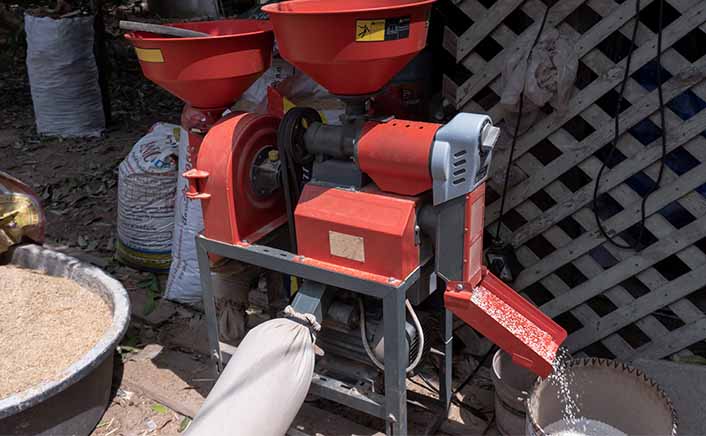
Small farmers and rural millers constitute the second largest segment, contributing approximately 25 to 26 percent to the market. They play a crucial role in the decentralized processing of rice across developing economies. This group is particularly significant in regions like South Asia, Southeast Asia, and Sub-Saharan Africa, where agricultural operations are fragmented and small-scale. These users generally rely on low-cost, compact milling machines with capacities below 1 ton per hour, making them very sensitive to pricing and accessibility issues. Government initiatives focused on rural development and agricultural mechanization have substantially aided this segment, with subsidy programs in countries like India covering up to 40 to 60 percent of equipment costs in certain cases. The rice milling machine market benefits from this widespread adoption, as small-scale users collectively make a significant contribution to total unit sales, despite their limited individual investment capacity. Moreover, increasing access to financing and cooperative models is gradually enabling these users to transition towards semi-automatic systems, thereby enhancing productivity and reducing post-harvest losses that can reach 10 to 15 percent.
Agricultural cooperatives account for approximately 14 percent of the market share and serve as an essential connection between small farmers and large-scale processing infrastructure. These cooperatives pool resources from multiple farmers to invest in medium-capacity milling machines, usually ranging from 1 to 5 tons per hour. This shared approach promotes improved efficiency, enhanced grain quality, and greater income realization for farmers by decreasing reliance on third-party millers. In many developing regions, cooperatives receive support from governmental and institutional funding, positioning them as key growth drivers within the rice milling machine market. Their significance is particularly pronounced in enhancing rural supply chains and enabling value addition at the local level, which is vital for improving food security and farmer profitability.
Food processing industries contribute around 12 percent of the market share and are increasingly embracing advanced rice milling machines to satisfy the rising demand for processed and packaged rice products. This segment encompasses companies involved in ready-to-cook rice, fortified rice, and other value-added products that necessitate precise milling and quality control. The global processed food industry is experiencing steady expansion, with demand for packaged staple foods growing at about 5 to 6 percent annually, thus creating substantial demand for consistent and high-quality raw materials. Within the rice milling machine market, food processing companies prioritize automation, hygiene standards, and efficiency, leading to greater adoption of modern integrated milling systems capable of delivering uniform output while meeting stringent food safety regulations.
Export-oriented rice processing units, comprising around 10 percent of the market share, represent a specialized segment focused on producing premium quality rice for international markets. These units require sophisticated milling technologies that achieve high head rice recovery rates, superior polishing, and precise grading to comply with stringent global standards. With global rice trade exceeding 55 million metric tons annually, exporters must ensure consistent quality to remain competitive, particularly in high-value segments such as basmati and specialty rice varieties. The rice milling machine market is significantly impacted by this segment, as export-oriented mills often invest in high-end equipment, including automated systems and optical sorters, which command higher prices and contribute disproportionately to market revenue. As international demand for premium rice continues to grow at a rate of about 3 to 4 percent annually, this segment is anticipated to maintain strong investment momentum.
Overall, the end-user landscape in the rice milling machine market is characterized by a blend of commercial operations, small-scale farmers, cooperatives, food processing industries, and export-oriented units, each playing a crucial role in the sector's dynamics.