U.S. UV Curing System Market Driven by High Speed Packaging, Electronics Miniaturization, and UV LED Adoption
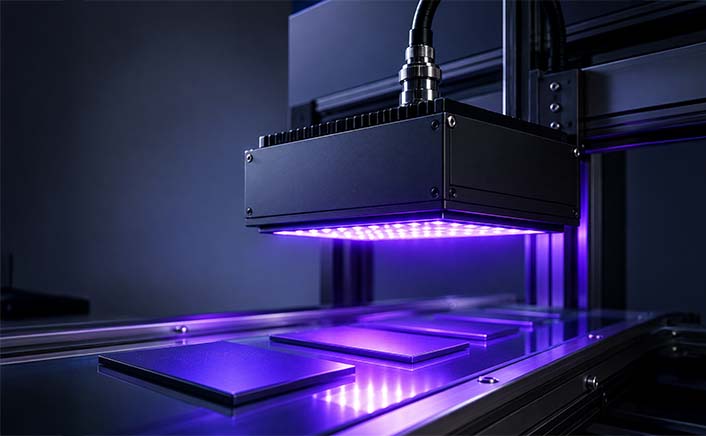
The structure of the end-use industry in the United States UV Curing System Market indicates a growing integration of high-speed, precision-based manufacturing technologies across various sectors, including packaging, electronics, automotive, healthcare, and industrial production. Currently, printing and packaging hold the largest market share, approximately 34%. This dominance stems from the fact that UV curing has become a fundamental operational necessity for modern label converting and digital packaging production.
The U.S. packaging industry faces significant pressure due to factors such as e-commerce expansion, the need for short-run customization, SKU proliferation, and same-day fulfillment requirements. These demands necessitate immediate curing capabilities to sustain production throughput. UV curing systems facilitate the instant solidification of inks and coatings, allowing substrates to move directly to cutting, lamination, rewinding, or shipping without drying delays. This advantage is crucial for flexible packaging and pressure-sensitive label production, where printing lines frequently exceed speeds of 250 feet per minute. Furthermore, major food and pharmaceutical packaging manufacturers are increasingly opting for UV LED curing systems, which generate less heat and accommodate low migration ink formulations needed for compliance with regulations.
The electronics and semiconductor sector constitutes the second-largest segment, capturing an estimated 19% of the market share. This growth is fueled by rising domestic investments in electronics manufacturing and advanced PCB assembly requirements. UV curing systems play a vital role in applications such as conformal coatings, optical bonding, semiconductor encapsulation, and microelectronic adhesive curing, as they provide precise curing control without subjecting sensitive components to excessive thermal stress. The ongoing reshoring of semiconductor manufacturing in the U.S., coupled with increasing investments in data centers, AI hardware, telecommunications equipment, and electronic vehicles (EV), is driving a substantial rise in demand for UV curing technologies. Additionally, UV LED systems are becoming essential in display manufacturing and wearable electronics, as they uniformly cure transparent adhesives while preserving optical clarity.
In the automotive sector, which contributes approximately 12% to the market, there is a noticeable shift toward UV curing systems as vehicles become more electronically integrated. Modern vehicles now incorporate sophisticated features such as infotainment displays, digital instrument clusters, ambient lighting systems, LiDAR sensors, cameras, and battery management electronics, all of which require UV-cured coatings and adhesives during assembly. The growth of electric vehicle manufacturing is further propelling this trend, as EV architectures contain a greater concentration of electronic modules and lightweight bonded materials compared to traditional internal combustion vehicles. Moreover, UV curing enhances rapid assembly line operations by reducing bonding cycle times and allowing immediate downstream processing.
Healthcare and medical applications represent nearly 10% of the U.S. market, driven by an increase in the production of disposable medical devices, wearable diagnostics, minimally invasive surgical tools, and drug delivery systems. UV curing systems are widely employed for catheter bonding, syringe assembly, needle attachment, and biosensor manufacturing due to their fast curing capabilities with minimal heat exposure. Medical manufacturers particularly appreciate UV curing technology for its compatibility with transparent plastics and miniature components used in cutting-edge healthcare devices. Additionally, the rise of home healthcare monitoring and wearable medical electronics is elevating the demand for compact UV curing solutions in precision manufacturing settings.
Industrial manufacturing accounts for roughly 8% of the market, encompassing applications such as wood finishing, metal coatings, plastic surface treatment, industrial adhesive bonding, and conveyorized production systems. Manufacturers are increasingly favoring UV curing over traditional thermal curing as it minimizes floor space requirements, reduces energy consumption, and shortens production cycles. Specifically in wood coatings, UV curing systems enable furniture and flooring manufacturers to achieve scratch-resistant finishes at significantly higher throughput levels compared to solvent-based drying systems. Trends in industrial automation across U.S. manufacturing facilities are also driving the adoption of integrated UV curing lines equipped with sensors, irradiance monitoring systems, and programmable curing controls.
The aerospace and defense sector, though smaller with around 5% market share, represents a crucial niche due to its stringent material performance requirements. UV curing systems are utilized in lightweight composite bonding, specialty protective coatings, optical assemblies, and aerospace electronics manufacturing, where consistent curing precision is essential. Defense contractors are increasingly seeking advanced coating technologies designed to enhance durability while reducing production times.