The U.S. Smart Window Market Is Projected To Reach USD 4.10 Billion By 2033, Driven By Energy-Efficient Building Retrofits And Smart Infrastructure Investments.
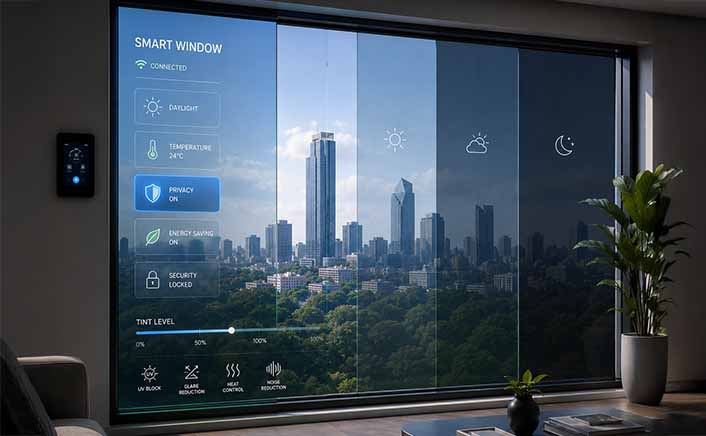
The U.S. Smart Window Market was valued at USD 1.90 billion in 2025 and is forecast to reach USD 4.10 billion by 2033, expanding at a CAGR of 10.1% during the forecast period, according to the latest industry analysis. The market is benefiting from increasing deployment of intelligent glazing systems across commercial buildings, airports, healthcare facilities, transportation infrastructure, and premium residential projects as building owners prioritize energy optimization and occupant comfort.
Smart windows are advanced glazing systems that dynamically control light transmission, glare, and solar heat gain using technologies such as electrochromic glass, suspended particle device (SPD) glass, and polymer-dispersed liquid crystal (PDLC) glass. Unlike traditional low-emissivity windows that provide static insulation, smart windows actively adjust tint levels based on sunlight exposure, occupancy conditions, or automated building management systems.
Rising electricity costs and stricter energy-efficiency regulations are accelerating adoption across commercial infrastructure. According to the U.S. Department of Energy, windows account for nearly 30% of heating and cooling energy loss in commercial buildings, underscoring the importance of advanced façade systems that reduce HVAC consumption. Smart windows are increasingly being integrated into office towers, airports, hospitals, universities, and hospitality projects where daylight optimization and thermal management directly influence operating costs.
Commercial buildings remain the largest end-user segment in the market due to rising investments in energy-efficient infrastructure modernization. Large commercial properties are increasingly deploying electrochromic glazing systems to reduce solar heat gain while maintaining natural daylight penetration. Airports and healthcare facilities are emerging as major deployment areas due to their continuous operational needs and high daytime energy consumption. Several U.S. airport terminals and healthcare campuses have already integrated dynamic glazing technologies to improve occupant comfort and reduce glare-related energy inefficiencies.
The market is also benefiting from the expansion of smart building adoption. Integration of smart windows with IoT-enabled building management systems enables automated tint adjustment based on sunlight intensity, indoor temperature, and occupancy. This capability is becoming increasingly valuable in intelligent commercial buildings focused on sustainability and ESG compliance.
Electrochromic technology currently accounts for the largest market share due to its scalability and compatibility with large commercial façades. These systems gradually adjust transparency using low-voltage electrical stimulation, enabling real-time daylight and heat management without mechanical blinds. SPD technology is gaining momentum in luxury automotive and aerospace applications because of its fast switching speed and deep-tint capability, particularly for panoramic roofs and aircraft windows. PDLC systems are increasingly used in interior privacy applications across offices, hospitality properties, and healthcare facilities.
Retrofit and renovation projects are expected to generate substantial long-term demand as aging U.S. commercial infrastructure undergoes energy-efficiency upgrades. A significant share of office buildings and institutional facilities in the U.S. were constructed before current sustainability standards became widespread, creating strong demand for façade modernization. Smart windows are increasingly viewed as long-term operational investments rather than premium architectural features alone.
Despite strong growth potential, the market continues to face adoption barriers related to high upfront costs and installation complexity. Commercial electrochromic glazing systems can exceed USD 90–120 per square foot installed, depending on façade requirements and automation integration. Retrofit projects often require additional structural modifications and electrical integration, increasing total deployment costs. However, long-term operational savings through reduced cooling loads and lower dependence on artificial lighting continue to strengthen the return-on-investment case for large infrastructure operators.
Regionally, the Western and Southern U.S. maintain the strongest adoption momentum due to higher cooling demand, stricter building-efficiency regulations, and large-scale commercial construction activity. States such as California, Texas, Arizona, and Florida continue to witness the rising deployment of intelligent façade technologies across commercial and transportation infrastructure.
Industry competition remains focused on electrochromic innovation, smart building integration, manufacturing scale, and energy-performance optimization. Market participants are increasingly investing in faster-switching technologies, improved durability, and IoT-enabled glazing systems to drive adoption in next-generation commercial infrastructure projects.