Commercial Buildings Accelerate Adoption of Perovskite Solar Cells to Maximize Rooftop Energy Generation Capacity
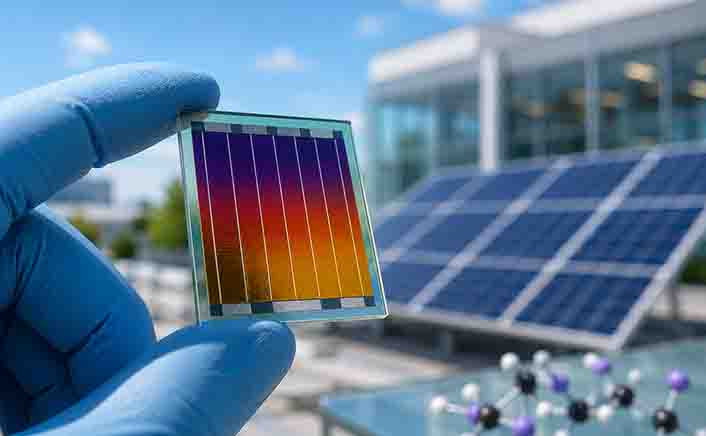
The U.S. Perovskite Solar Cells Market is anticipated to have a significantly different end-user structure compared to the conventional crystalline silicon solar industry, primarily because commercialization is being driven by performance enhancements rather than merely cost advantages. During the early stages of commercialization, utility-scale projects are expected to dominate, accounting for approximately 58–62% of market demand. This prevalence is attributed to utility developers' ability to swiftly assess and implement new technologies when they can demonstrate measurable improvements in energy yield.
Perovskite-silicon tandem modules are projected to achieve efficiency levels of around 28–30% in initial commercial deployment, outpacing the 21–24% efficiency typically found in mainstream silicon modules. For large-scale solar infrastructure, even a slight improvement in module efficiency can significantly enhance project economics by boosting energy production without a corresponding rise in land use, transmission infrastructure, or additional costs associated with tracker systems and balance-of-system expenditures. In high-growth markets like Texas, California, Arizona, Nevada, and Florida, project developers are increasingly focusing on maximizing energy generation from existing sites, particularly where transmission capacity has become a limiting factor. Hence, the utility segment is likely to serve as the primary platform for commercializing perovskite technology, as developers can justify the adoption of new technologies based on quantifiable gains in energy output and a lower levelized cost of electricity. Furthermore, utility operators typically possess the necessary technical expertise and financial resources to conduct thorough performance validations, making them more inclined than residential consumers to embrace next-generation photovoltaic technologies during their early market introduction.
The commercial sector is forecasted to be the second-largest end-user category, representing about 20–23% of market demand during the forecast period. Commercial rooftop owners face distinct challenges that make high-efficiency modules particularly appealing. Facilities such as warehouses, logistics centers, retail shops, office buildings, educational campuses, and data centers often have limited rooftop space compared to their electricity consumption needs. Unlike utility-scale projects that can access additional land, commercial property owners usually work with fixed rooftop areas, prioritizing technologies that maximize electricity generation from each square meter. This is crucial for data centers, whose electricity demands continue to rise due to artificial intelligence workloads, cloud computing proliferation, and investments in digital infrastructure. As these operators seek to improve sustainability metrics and mitigate exposure to fluctuating electricity prices, high-efficiency tandem modules could become a favorable option for on-site energy generation. Building-integrated photovoltaic applications also present opportunities in the commercial space, as semi-transparent perovskite technologies can be integrated into building facades, skylights, and glass structures, enabling property owners to generate electricity without compromising architectural design. This innovation adds an extra layer of value beyond traditional rooftop solar setups and is expected to foster gradual growth in the commercial end-user segment over the forecast period.
Industrial users are projected to constitute about 11–13% of total market demand. Industrial facilities, which typically use considerable amounts of electricity, are increasingly under pressure to reduce carbon emissions while remaining competitive on costs. Sectors such as manufacturing plants, chemical facilities, semiconductor fabs, food processing sites, and advanced manufacturing centers are significantly investing in renewable energy procurement. Perovskite solar cells offer these operators a chance to enhance renewable energy generation within restricted facility footprints. In various industrial settings, available rooftop space may fall short of offsetting a substantial portion of electricity needs when conventional modules are employed. Higher-efficiency tandem modules offer a potential solution, enabling greater renewable energy integration without necessitating additional land acquisition. Additionally, industrial users are often leading participants in corporate sustainability initiatives, with many aiming for science-based emissions reduction targets and net-zero commitments. Consequently, industrial buyers may be more inclined to invest in advanced solar technologies if they believe that increased electricity production will improve the economics of on-site renewable energy systems. The industrial sector may also benefit from federal incentives that promote domestic manufacturing and clean energy adoption, especially for facilities engaged in sustainable practices.