How Fishing Boats and Electric Pontoon Vessels Are Transforming the U.S. Marine Battery Industry
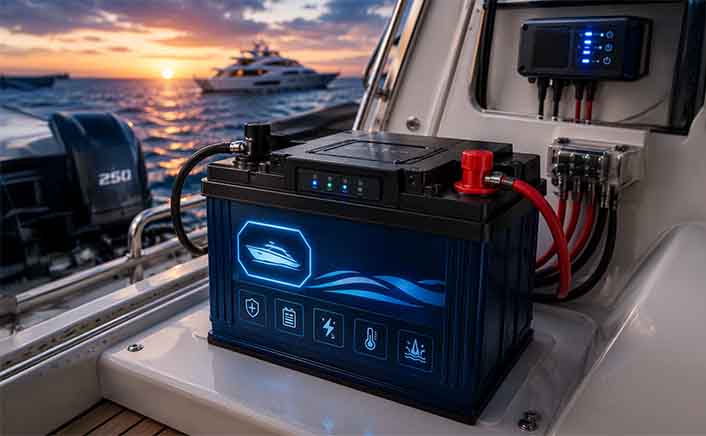
Recreational boats are projected to hold a dominant position in the United States Marine Battery Market capturing an estimated 34% share by 2025. This dominance can be attributed to the country's vast recreational boating ecosystem, which boasts over 11 million registered recreational boats operating in various settings, including inland waterways, coastal regions, and lakes. Demand for batteries within this segment is on a rapid rise as boat owners increasingly adopt lithium-powered trolling motors, navigation systems, fish finders, HVAC systems, onboard entertainment electronics, and auxiliary energy storage systems. The trend of electrification in recreational boats is not limited to luxury vessels; mid-range pontoon and leisure boats are also integrating high-capacity lithium battery systems to enhance runtime performance and lower maintenance needs. The weight reduction offered by lithium marine batteries—nearly 60% to 70% lighter than comparable lead-acid systems—while providing significantly greater usable energy capacity, is a crucial factor. Boat owners are increasingly willing to invest in premium maintenance-free batteries that deliver faster charging, longer operational life, and improved onboard energy reliability.
Fishing boats represent about 22% of market demand and are one of the fastest-growing segments in the marine battery industry. Modern sport fishing and tournament boats increasingly rely on 24V, 36V, and 48V lithium battery systems to power high-thrust trolling motors, live sonar imaging systems, GPS platforms, fish finders, and wireless communication technologies. The advanced electronics for fishing significantly boost onboard power consumption, driving the need for high-capacity deep cycle lithium batteries that can provide extended runtime. Tournament fishing operations place a premium on lightweight battery systems, as reduced vessel weight enhances acceleration, maneuverability, and fuel efficiency during lengthy fishing excursions. The swift growth of lithium trolling motor systems has reshaped the competitive landscape of the marine battery market, leading to heightened replacement demand for older AGM and lead-acid technologies.
Pontoon boats, contributing nearly 11% of the market, are becoming an important category for electrification driven by consumer preference for quiet, environmentally friendly leisure boating experiences. Electric pontoon boats are increasingly adopting lithium propulsion batteries, solar charging systems, and smart battery management technologies tailored for recreational cruising and inland lake transportation. This segment is benefiting from the expansion of marina charging infrastructure in key recreational boating states such as Florida, Michigan, and California. Manufacturers of pontoon boats are collaborating with marine battery suppliers to offer factory-integrated electric propulsion packages aimed at premium recreational consumers.
Yachts account for roughly 9% of the market and yield a notable revenue contribution due to their requirement for large battery banks to support propulsion systems, stabilization technologies, onboard automation, HVAC systems, refrigeration, lighting, and entertainment infrastructure. Hybrid yacht platforms are increasingly leveraging high-voltage lithium battery architectures with capacities exceeding several hundred kilowatt-hours to reduce reliance on generators and enhance onboard energy efficiency. Luxury yacht owners are prioritizing silent operation capabilities, further amplifying the demand for battery-powered auxiliary systems and hybrid propulsion technologies.
Commercial vessels and ferries together contribute approximately 12% of total market demand and are experiencing growth driven by maritime decarbonization initiatives. Hybrid electric ferries, tugboats, offshore support vessels, and harbor craft are progressively adopting lithium iron phosphate battery systems due to their superior thermal stability, long cycle life, and operational reliability. Operators in the commercial marine sector are particularly focused on decreasing diesel fuel consumption, reducing maintenance costs, and minimizing port-related emissions. High-voltage marine battery systems exceeding 400V are increasingly common in hybrid vessel applications, where they support low-speed maneuvering, hotel load operations, and energy recovery systems. Numerous electrification projects along coastal and inland waterways across the United States are creating long-term opportunities for large-scale deployment of marine batteries.
Sailboats maintain about 6% of the market share and are transitioning to lithium-based auxiliary power systems as replacements for traditional lead-acid batteries. Operators of sailboats prioritize lightweight energy storage solutions, as the weight of the battery directly influences sailing efficiency and vessel balance. Furthermore, long-duration offshore sailing applications demand reliable battery systems capable of supporting navigation, communication, desalination, refrigeration, and integrating renewable energy sources.