The Cascade Effect: How Innovation in High-Density Cooling Will Redefine the Broader U.S. Data Center Coolers Market
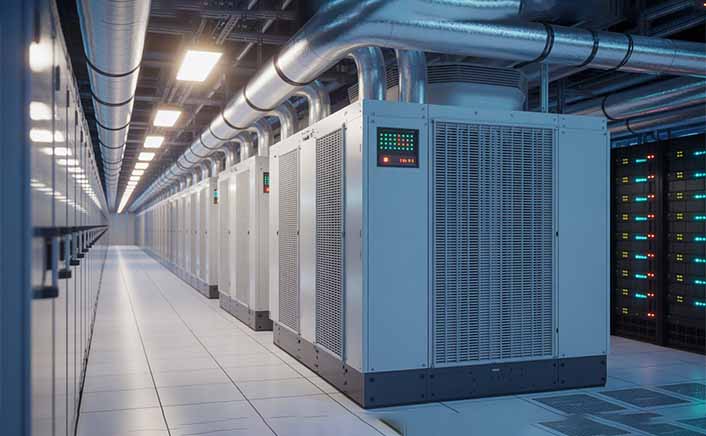
The segmentation of the U.S. Data Center Coolers Market by rack power density reveals a market experiencing significant and rapid stratification, with value creation increasingly centered at the highest thermal loads. A key insight is that the High-Density & Extreme-Density segment (greater than 30 kW/rack), despite being the smallest in terms of rack quantity, captures the largest market revenue share estimated between 40% and 50%. This shift in the traditional volume-value relationship is a defining trend in the industry.
In terms of value, the U.S. Data Center Coolers Market was valued at USD 6,190 million in 2023 and is estimated to reach a value of 16,894 million by 2032 with a CAGR of 10.4% during the forecast period.
The growth of this segment is primarily driven by the escalating computational demands of artificial intelligence and high-performance computing, where heat fluxes have surpassed the physical limits of air convection. As a result, it has become synonymous with the adoption of liquid cooling technologies, positioning it as a critical area for innovation and premium pricing. The high market share is indicative of the substantial costs associated with requisite infrastructure, including complex Coolant Distribution Units (CDUs), manifold networks, cold plates, and immersion tanks, all of which are priced significantly higher than advanced air handlers. This segment's growth is exponential rather than incremental, steering the entire market's technological roadmap and investment focus toward liquid-based solutions.
In contrast, the Medium-Density segment (10-30 kW/rack) serves as the stable core of the market by volume, representing a vast installed base of general-purpose cloud and enterprise servers. This segment maintains a significant value share of 35-45%, highlighting its ongoing economic relevance. It features intense technological competition between highly optimized, variable-speed air cooling systems and emerging liquid-assisted or hybrid solutions.
As average densities trend upward toward 20-25 kW/rack, the efficiency and operational cost benefits of rear-door heat exchangers or direct-to-chip cooling for hotspots become increasingly attractive, resulting in a transitional zone where both air and liquid technologies coexist. This segment acts as a critical indicator of broader market evolution; as liquid cooling prices decline and integration becomes simpler, the lower end of this segment is likely to experience a technological shift, representing a substantial future market opportunity for liquid cooling providers.
Conversely, the Low-Density segment (under 10 kW/rack) comprises commoditized solutions and is experiencing a managed decline in relative value share. Predominantly served by traditional computer room air conditioners (CRACs), this segment is highly cost-sensitive and shows little motivation for technological disruption. Its share of 15-25% is maintained by a large legacy installed base, edge computing deployments, and specific low-power applications. Nevertheless, this segment is increasingly disconnected from the high-growth, high-innovation dynamics of the broader market, primarily serving as a steady, albeit slow-growing, revenue stream for manufacturers of basic cooling equipment, while R&D and strategic marketing investments increasingly favor higher-density applications.
In conclusion, this density-based segmentation illustrates a distinctly bimodal market. One tier is characterized by high velocity, innovation-driven initiatives aimed at addressing extreme thermal challenges for AI, commanding premium prices and capturing the majority of new market value. The other tier is more gradualist, focused on the efficient and cost-effective cooling of the general computing infrastructure. For cooling providers, the strategic imperative lies in mastering the high-density frontier to secure growth and margin expansion while competing on efficiency and total cost of ownership within the medium-density core. The trajectory of the U.S. market will be shaped by the rate at which technologies and economics proven in the high-density segment permeate the medium-density mainstream, a process that is already well underway.