The increasing emphasis on digital engagement, real-time communication, and immersive visual experiences is positioning commercial displays as core infrastructure assets rather than auxiliary hardware across US enterprises.
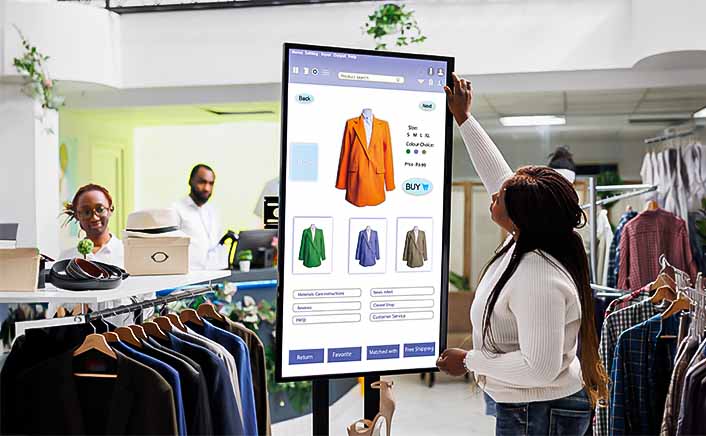
The U.S. commercial display Market is growing steadily, supported by widespread use in retail, corporate offices, hospitality, healthcare, education, and public infrastructure. Initially fueled by simple digital signage and standard LCD installations, it has evolved to include large-format displays, LED video walls, and integrated enterprise solutions. Retail media networks, workplace collaboration tools, and transportation information displays now drive long-term demand. Consequently, growth depends more on replacement cycles, technology upgrades, and system integrations than on one-off discretionary buys.
The US Commercial Display Market was estimated at approximately USD 14.7 billion in 2025 and is projected to reach approximately USD 22.6 billion by 2033, with a CAGR of roughly 5.6%. This expansion is driven by increasing enterprise digitization, the adoption of omnichannel retail strategies, and ongoing investments in large-format, high-resolution display technologies. Nonetheless, growth is steady rather than rapid, owing to the market’s maturity, longer replacement cycles, and capital-intensive nature.
Retail and enterprise applications dominate the US market.
Retail environments dominate the commercial display market, driven by digital signage, promotional screens, and in-store video walls that enhance brand engagement and enable retail media monetization. Next in demand are the corporate and enterprise sectors, with a focus on meeting rooms, collaboration spaces, control rooms, and internal communications. These sectors benefit from ongoing replacement needs, centralized purchasing, and a preference for premium, reliable displays. Although the healthcare, education, and hospitality sectors experience lower unit sales, they add value through more stringent specification requirements and longer-term contracts.
Large-format and LED displays emerge as high-value growth segments.
Large-format displays and direct-view LED solutions are rapidly expanding segments in the US market, driven by the need for immersive visuals in retail flagship stores, corporate lobbies, sports venues, and command centers. Their adoption is facilitated by declining pixel-pitch costs, improved energy efficiency, and greater design versatility. While deployment volumes remain lower than those of standard panels, their notably higher average selling prices are a key driver of overall market value growth.
Urban and high-commercial-density regions lead demand, with the South showing strong momentum.
The West Coast and Northeast are at the forefront of the U.S. commercial display market, owing to their extensive retail presence, corporate headquarters, and early adoption of advanced display technologies. Key states such as California, New York, and Massachusetts account for a significant share of high-value installations. The Southern region is rapidly expanding, driven by population growth, commercial real estate expansion, and increased infrastructure investment. Conversely, demand in the Midwest remains steady, primarily driven by replacement demand in the enterprise, healthcare, and education sectors.
Integration-driven demand offers greater stability than discretionary deployments.
Demand stability varies across applications; retail chains, corporate enterprises, and transportation systems tend to be more resilient owing to their standardized deployment models and operational requirements. Conversely, discretionary commercial installations are more vulnerable to economic fluctuations and capital expenditure limits. As a result, suppliers are increasingly emphasizing comprehensive solutions, software integration, and long-term service agreements over standalone hardware sales.
Long-term market outlook remains positive despite cost and budget constraints.
Despite ongoing challenges, including high upfront costs, complex installation, and budget constraints among smaller businesses, the long-term prospects for the U.S. Commercial Display Market appear promising. Improvements in display efficiency, content management, and enterprise-specific features are expected to encourage ongoing adoption. Over time, growth will likely be driven by technological updates, premium enhancements, and greater integration into enterprise and public infrastructure systems.
Competitive Landscape
The US Commercial Display Market is quite competitive, featuring a blend of global electronics giants and specialized professional display providers. Major players emphasize technological innovation, solution integration, and robust partnerships with system integrators. Competition now primarily focuses on display quality, lifecycle support, and compatibility with enterprise software, rather than price alone. Key companies include Samsung Electronics, LG Electronics, Sony Corporation, Sharp NEC Display Solutions, Panasonic Connect, Barco, Christie Digital Systems, Philips Professional Display Solutions, ViewSonic, and Leyard Planar.