Demand Trends for Below 20 kN to Above 300 kN Propulsion Systems in the U.S. 3D Printed Jet Engines Market
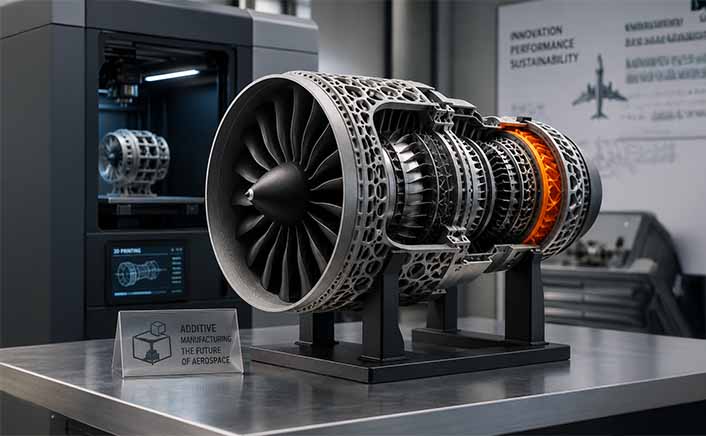
The thrust class segmentation of the U.S. 3D Printed Jet Engines Market highlights the growing adoption of additive manufacturing across various aerospace propulsion systems, ranging from compact unmanned aerial vehicle (UAV) engines to high-thrust commercial and military turbofan engines. Each thrust category exhibits unique adoption trends driven by aircraft mission needs, certification challenges, production economics, and advancements in metal additive manufacturing technologies.
The Below 20 kN segment is one of the fastest-growing categories, primarily fueled by the rapid deployment of tactical UAVs, loitering munitions, target drones, autonomous reconnaissance aircraft, experimental propulsion platforms, and emerging urban air mobility concepts. These compact engines significantly benefit from additive manufacturing, as they allow for intricate internal geometries that enhance combustion efficiency while reducing weight. Manufacturers increasingly leverage Powder Bed Fusion (PBF) to produce components such as fuel injectors, combustor liners, turbine wheels, and exhaust assemblies with layer thicknesses of 20–60 microns, achieving dimensional accuracy that traditional machining methods often cannot match. In many small turbojet programs, additive manufacturing has led to a reduction in component count by 70–90% and a decrease in material waste by 40–70% compared to subtractive manufacturing. This segment is anticipated to capture a significant share of future engine production volumes as defense agencies continue to expand their procurement of unmanned systems.
The 20–100 kN thrust class represents the largest commercial opportunity within the U.S. 3D Printed Jet Engines Market, catering to regional aircraft, business jets, advanced military trainers, and various next-generation unmanned combat aerial systems (UCAS). Engines in this range necessitate a balance of high thrust, fuel efficiency, and reliability, making them suitable candidates for additive manufacturing in components like combustors, fuel nozzles, compressor stators, turbine blades, and heat exchangers. Modern additive manufacturing allows for the creation of complex internal cooling channels that enhance thermal management and permit higher operating temperatures, directly improving engine efficiency. Aerospace manufacturers report that additively manufactured fuel nozzles can consolidate 15–20 individual parts into a single printed component, streamlining assembly processes while enhancing durability and reducing maintenance needs. The growing use of multi-laser metal additive manufacturing systems with build volumes exceeding 600 × 600 × 600 mm and laser powers above 1 kW is also enhancing production throughput for engines in this thrust range. This segment is expected to see strong adoption as business aviation and defense modernization efforts increasingly emphasize lightweight propulsion systems with shorter manufacturing lead times.
The 100–300 kN thrust class is central to the propulsion needs of advanced military fighter aircraft, large business aircraft, military transport platforms, and many commercial narrow-body aircraft. This segment demands high-performance materials capable of withstanding extreme thermal and mechanical stresses. Consequently, nickel-based superalloys such as Inconel 718, Inconel 625, and Hastelloy X, along with titanium alloys and ceramic matrix composites (CMCs), dominate additive manufacturing in this category. Components like turbine blades, combustor casings, compressor blisks, afterburner structures, and structural engine supports increasingly utilize Powder Bed Fusion and Directed Energy Deposition technologies to streamline production complexity while enhancing performance. Additive manufacturing also facilitates topology optimization, enabling engineers to remove excess material without compromising structural integrity, resulting in measurable weight savings that contribute to lower fuel consumption throughout an engine's operational life. The integration of digital manufacturing workflows further accelerates prototype development cycles from several months to just weeks, allowing engine manufacturers to expedite product validation and qualification. Even though engines in this class require extensive certification and rigorous non-destructive testing, advancements in automated inspection, in-situ process monitoring, and hot isostatic pressing (HIP) are improving production consistency and fatigue performance.
The Above 300 kN thrust class represents the highest-value segment within the U.S. 3D Printed Jet Engines Market, despite its comparatively lower production volumes. These engines power wide-body commercial aircraft, heavy military transport aircraft, strategic bombers, and specialized aerospace propulsion platforms that require extremely high thrust outputs. Engines in this category often consist of thousands of precision-engineered components, creating substantial opportunities for additive manufacturing.