North America Renewable Natural Gas Vehicles Market to Reach USD 7.20 Billion by 2033 as Commercial Fleet Decarbonization Accelerates
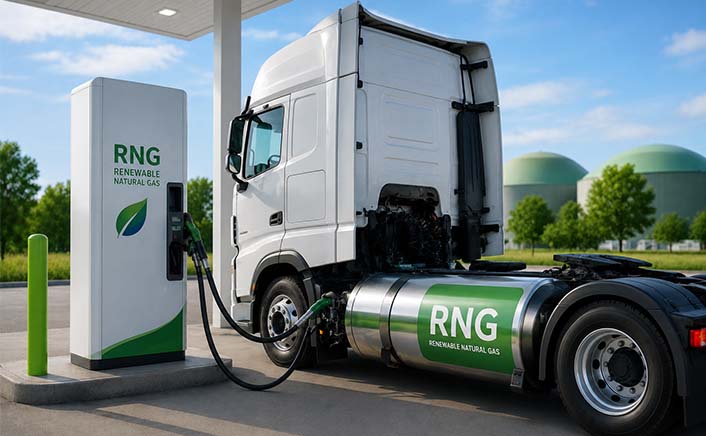
Growing production of renewable fuel, supportive government policies, and increasing adoption across refuse, logistics, and public transit fleets are strengthening the North American Renewable Natural Gas Vehicles Market.
The North American Renewable Natural Gas (RNG) Vehicles Market was valued at USD 3.80 billion in 2025 and is projected to reach USD 7.20 billion by 2033, registering a CAGR of 8.4% during 2026–2033, based on recent industry analysis.
Renewable natural gas has become one of the fastest-growing alternative transportation fuels for medium- and heavy-duty commercial vehicles. Produced from landfill gas, livestock manure, wastewater treatment plants, agricultural residues, and organic waste, RNG enables fleets to significantly reduce lifecycle greenhouse gas emissions while utilizing existing compressed natural gas (CNG) and liquefied natural gas (LNG) vehicle technologies. The market recorded annual sales of 13,000 RNG-powered commercial vehicles in 2025, with sales projected to reach 24,900 vehicles by 2033 as fleet operators accelerate investments in sustainable transportation.
North America remains the global leader in renewable natural gas transportation. According to the U.S. Department of Energy, more than 75% of all transportation natural gas consumed in the United States is now renewable natural gas, reflecting the rapid transition toward cleaner fuels. The region also operates more than 400 renewable natural gas production facilities and over 1,600 public and private natural gas fueling stations, creating a well-established ecosystem for commercial vehicle deployment.
Supportive government regulations continue to drive market expansion. Programs such as the U.S. Renewable Fuel Standard (RFS), California's Low Carbon Fuel Standard (LCFS), and Canada's Clean Fuel Regulations improve project economics through renewable fuel credits and carbon reduction incentives. These policies are encouraging investments across the renewable fuel value chain while helping commercial fleets lower operating emissions without major infrastructure changes.
Commercial fleet operators are increasingly selecting RNG vehicles as a practical decarbonization solution. Waste management companies WM and Republic Services continue expanding fleets powered by renewable natural gas generated from landfill operations, creating closed-loop waste-to-fuel business models. Logistics providers, including UPS and regional freight carriers, are integrating RNG-powered trucks into their operations to reduce Scope 1 emissions and support corporate ESG objectives. Public transit agencies across California, Texas, New York, and several Canadian provinces are also replacing aging diesel buses with RNG-powered alternatives through federal and provincial clean transportation programs.
Technology innovation is further strengthening market competitiveness. Leading manufacturers, including Cummins, PACCAR, Daimler Truck North America, and Volvo Trucks North America, are introducing next-generation natural gas engines with higher thermal efficiency, lower methane emissions, and compatibility with 100% renewable natural gas. Simultaneously, investments in landfill gas recovery, dairy manure digesters, and agricultural waste conversion projects continue expanding renewable fuel availability throughout North America.
Among vehicle categories, Heavy-Duty Trucks represent the largest market segment due to strong adoption across freight transportation and commercial logistics. Refuse Collection Vehicles are expected to experience the fastest growth, supported by municipal sustainability initiatives and the integration of landfill gas utilization. By application, Waste Management remains the dominant segment. At the same time, Logistics & Freight Transportation is projected to record the highest growth as fleet operators pursue lower-carbon transportation solutions without compromising vehicle range or operational efficiency.
Although battery-electric and hydrogen fuel cell technologies are gaining momentum, renewable natural gas continues to provide an immediately deployable solution for commercial fleets requiring long driving ranges, rapid refueling, and proven operational reliability. Expanding renewable fuel production capacity, favorable regulatory frameworks, and increasing corporate sustainability commitments are expected to sustain market growth throughout the forecast period.