Rising Cardiovascular Disease Burden in North America AI in Cardiology Market, Driving AI Adoption in Cardiology.
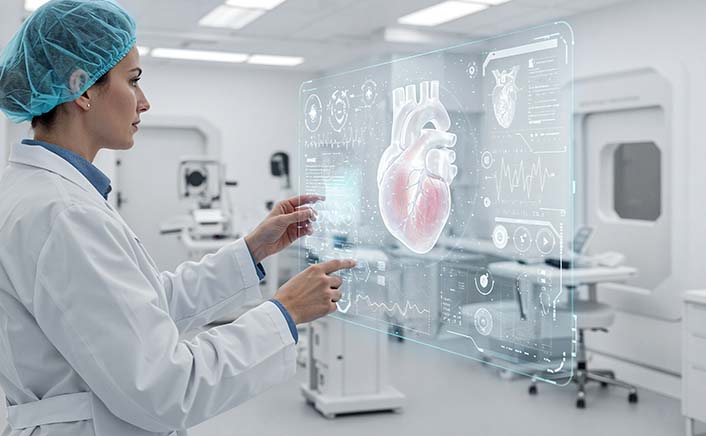
The North America AI in Cardiology Market is projected to experience significant growth, expanding from USD 0.65 billion in 2023 to USD 4.52 billion by 2033, with a robust CAGR of 21.40%. This growth is attributed to the increasing prevalence of cardiovascular diseases and the rising adoption of AI technologies for diagnosis, imaging, and treatment planning. Year-on-year expansion indicates a growing clinical acceptance and investment in digital healthcare.
Advanced AI tools are enhancing diagnostic accuracy and improving patient outcomes while alleviating clinician workloads. Additionally, a strong healthcare infrastructure and ongoing technological advancements further bolster the rapid expansion of the market throughout the forecast period.
Increasing heart-related cases is driving demand for AI tools for early diagnosis and continuous cardiac monitoring.
The growing incidence of cardiovascular diseases (CVDs) across North America is a primary factor driving the adoption of AI in cardiology. Conditions such as coronary artery disease, heart failure, arrhythmias, and stroke are becoming increasingly common due to aging populations, sedentary lifestyles, obesity, and diabetes. This rising disease burden places significant pressure on healthcare systems to improve early detection, diagnosis, and long-term management. AI-powered tools help clinicians analyze large volumes of patient data, including imaging, ECG signals, and electronic health records, to identify patterns that may not be visible through conventional methods. These technologies enable earlier diagnosis and risk prediction, which can significantly reduce mortality rates and healthcare costs. As patient volumes continue to increase, healthcare providers are increasingly relying on AI to enhance efficiency and deliver more accurate, timely cardiac care.
Well-established hospitals and digital systems enable faster adoption and integration of AI in cardiology workflows.
North America’s highly developed healthcare infrastructure plays a crucial role in accelerating the adoption of AI in cardiology. The region is equipped with advanced hospitals, specialized cardiac care centers, and widespread access to digital health technologies such as electronic health records (EHRs) and telemedicine platforms. This strong foundation allows seamless integration of AI solutions into existing clinical workflows. Additionally, healthcare professionals in the region are generally more trained and open to adopting innovative technologies, further supporting implementation. High availability of diagnostic imaging systems such as MRI, CT scans, and echocardiography also generates large datasets that AI systems can utilize for improved accuracy. Furthermore, the presence of leading technology companies and research institutions fosters collaboration between healthcare and technology sectors. This synergy enables faster deployment of AI tools, ultimately improving patient outcomes, operational efficiency, and decision-making in cardiology practices.
Growing approvals of AI-based cardiac solutions boost trust and accelerate market adoption.
Regulatory support in North America, particularly from the U.S. Food and Drug Administration, is a significant driver of AI adoption in cardiology. The FDA has established clear pathways for the approval and commercialization of AI-based medical devices, including software as a medical device (SaMD). Over the past few years, there has been a notable increase in FDA approvals for AI-powered diagnostic and monitoring tools used in cardiology. These approvals ensure that products meet strict safety, efficacy, and quality standards, which helps build confidence among healthcare providers and patients. In addition, regulatory frameworks are evolving to accommodate adaptive AI systems that continuously learn from new data. This progressive approach encourages innovation while maintaining patient safety. As a result, companies are more willing to invest in developing AI solutions, knowing there is a structured approval process that supports market entry and scalability.
Strong funding from governments and investors fuels rapid development of advanced cardiology AI technologies.
North America is a global leader in investment in artificial intelligence and healthcare innovation, which significantly drives the AI in cardiology market. Venture capital firms, private equity investors, and government funding bodies actively support startups and established companies developing AI-based healthcare solutions. This strong financial backing enables rapid research and development, clinical validation, and commercialization of new technologies. Many startups are focusing specifically on cardiology applications, such as AI-powered imaging analysis, remote patient monitoring, and predictive analytics. Additionally, collaborations between technology companies, academic institutions, and healthcare providers create a robust innovation ecosystem. Major technology hubs like Silicon Valley and Boston play a vital role in fostering these advancements. Continuous funding not only accelerates technological progress but also enhances competition, leading to more efficient and cost-effective solutions, ultimately benefiting both healthcare providers and patients.
Continuous improvements in AI algorithms enhance accuracy in diagnosis, prediction, and personalized treatment.
Rapid advancements in artificial intelligence, particularly in machine learning and deep learning, are transforming cardiology practices in North America. Modern AI algorithms can process complex datasets, including medical images, ECG waveforms, and patient histories, with remarkable accuracy and speed. These technologies enable automated detection of abnormalities such as arrhythmias, heart valve disorders, and blockages in coronary arteries. Deep learning models, especially convolutional neural networks (CNNs), are increasingly used for image-based diagnostics, improving the precision of echocardiograms, CT scans, and MRIs. Additionally, AI supports predictive analytics, allowing clinicians to assess a patient’s risk of developing cardiovascular diseases and recommend preventive measures. Integration with wearable devices and remote monitoring systems further enhances patient care by enabling real-time tracking of cardiac health. As these technologies continue to evolve, they are expected to further improve clinical outcomes, reduce diagnostic errors, and optimize treatment strategies in cardiology.
Competitive Landscape
Some of the major companies operating within the North America AI in Cardiology Market: Cleerly, Inc., Viz.ai, Inc., Heartflow, Inc., Cleerly, Inc. , iRhythm Technologies, Inc., CardiAI Inc., GE HealthCare Technologies, Inc., IDOVEN S.L. and Others.