Rising Focus On Road Safety, Increasing Integration Of Advanced Driver Assistance Systems, And Growing Demand For Enhanced Visibility Solutions Are Driving The Adoption Of Automotive Night-Vision Systems In Japan.
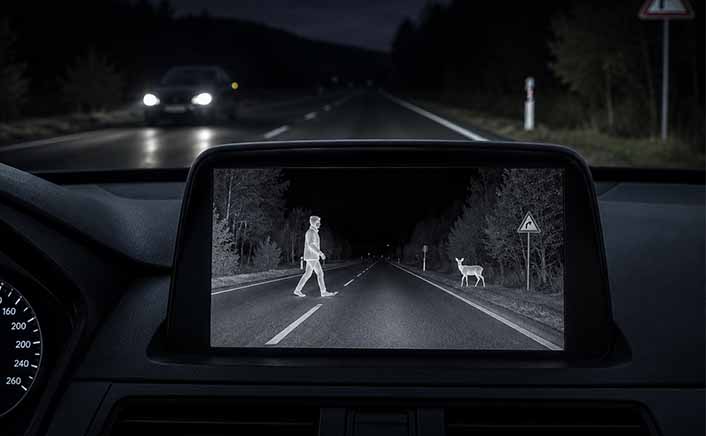
The Japan Automotive Night Vision System Market reached USD 0.21 billion in 2025 and is projected to grow to USD 0.46 billion by 2033, registering a CAGR of 10.5% from 2026 to 2033. Market growth is primarily driven by the rising adoption of premium safety technologies in luxury and high-end vehicles, alongside increasing awareness of pedestrian and nighttime driving safety. Japan’s strong automotive manufacturing ecosystem and ongoing advancements in sensor technologies are further accelerating the integration of night-vision systems into modern vehicles.
Japan’s automotive landscape is highly advanced and innovation-driven, with leading OEMs such as Toyota, Lexus, and Nissan consistently investing in next-generation safety systems. The market is closely aligned with the broader evolution of ADAS technologies, where night vision systems are increasingly positioned as a complementary solution to radar, LiDAR, and camera-based systems. The country’s aging population and higher proportion of nighttime pedestrian incidents have made safety enhancements a critical priority, encouraging the adoption of technologies that improve driver awareness and reduce accident risks.
Consumer and OEM behavior in Japan reflects a strong inclination toward premiumization and integrated safety solutions. Night vision systems are predominantly offered as factory-installed features within luxury vehicles, where buyers are more willing to invest in advanced safety and comfort functionalities. Large automotive manufacturers are embedding these systems within comprehensive ADAS packages rather than offering them as standalone features, enabling better system synergy and enhanced performance. While aftermarket adoption remains limited, a gradual emergence of retrofit solutions is catering to niche consumer segments and specialized fleet applications.
Urban regions such as Tokyo, Osaka, and Nagoya play a central role in market demand due to higher concentrations of premium vehicle ownership and advanced infrastructure. At the same time, rural and semi-urban areas contribute to demand through safety-driven use cases, particularly in regions with limited street lighting and higher exposure to wildlife crossings. The combination of urban premium demand and rural safety requirements creates a balanced market structure, supporting steady growth across different geographic segments within Japan.
Technology evolution is a key factor shaping the competitive landscape. Far-infrared (FIR) systems dominate because they can detect heat signatures, making them highly effective for pedestrian detection in complete darkness. At the same time, near-infrared (NIR) systems and sensor fusion technologies are gaining traction, enabling improved accuracy and integration with broader ADAS platforms. The increasing use of artificial intelligence and machine learning in image processing is enhancing object recognition capabilities, reducing false positives, and improving overall system reliability.
Pricing dynamics remain a defining characteristic of the market, with night vision systems typically priced in the premium range of USD 2,800 to USD 4,000 per unit. While advancements in semiconductor manufacturing and economies of scale are gradually reducing costs, the technology remains relatively expensive compared to other ADAS features. As a result, adoption is expected to expand incrementally, primarily in high-end vehicle segments, before reaching broader market penetration.
The competitive landscape is characterized by the presence of both domestic and global players, including Denso Corporation, Hitachi Astemo, Valeo, Bosch, and Teledyne Technologies. These companies are focusing on enhancing sensor performance, improving system integration, and reducing costs through innovation and strategic collaborations. The acquisition of thermal imaging specialist FLIR Systems by Teledyne Technologies has further strengthened Teledyne's capabilities in infrared sensing, contributing to technological advancements in automotive night-vision solutions.
Digital transformation and the increasing role of software-defined vehicles are also influencing market dynamics. Automotive manufacturers are integrating night-vision systems with digital dashboards and head-up displays, improving the user experience and enabling real-time visualization. Additionally, the shift toward autonomous and semi-autonomous driving is expected to create new opportunities for night vision systems, particularly as part of sensor fusion frameworks designed to enhance environmental perception.
Japan’s automotive night-vision system market is expected to maintain steady growth momentum over the forecast period, supported by ongoing innovation, a regulatory focus on safety, and evolving consumer preferences. As OEMs prioritize advanced safety features and integrated ADAS solutions, the demand for reliable, high-performance night-vision systems will continue to grow. Long-term growth opportunities will depend on cost optimization, technological advancements, and manufacturers' ability to integrate these systems seamlessly into next-generation vehicle platforms.