Rising Geriatric Population and Growing Demand for Assistive Mobility Solutions Drive Global Walkers and Rollators Market Growth.
The Global Walkers and Rollators Market is set to experience steady growth as the rising elderly population, increasing prevalence of mobility-related disorders, and growing emphasis on fall prevention and independent living continue to drive demand for assistive walking devices worldwide. According to the latest market analysis, the market is projected to grow from USD 2.79 Billion in 2025 to approximately USD 5.09 Billion by 2033, registering a compound annual growth rate (CAGR) of 7.80% during the forecast period.
As the global population continues to age and life expectancy rises, the need for reliable and comfortable mobility aids has become increasingly important for maintaining independence and quality of life among elderly and post-surgical individuals. Walkers and rollators help users manage balance impairments, arthritis, osteoporosis, Parkinson's disease, and post-operative recovery, reducing fall risk while supporting active daily living. These devices are increasingly recognized as essential tools in both home-care and clinical rehabilitation settings.
The market is witnessing significant momentum through continued innovation in lightweight aluminum alloy and carbon-fiber frame construction, foldable and height-adjustable designs, ergonomic handgrips, and integrated seating and storage features. Advanced rollator models featuring hand-operated braking systems, sensor-based fall detection, and GPS connectivity are further enhancing user safety and independence. These innovations are helping manufacturers improve product durability while reducing overall device weight and improving user comfort.
Healthcare providers, rehabilitation centers, and elderly care organizations continue to strengthen partnerships with mobility aid manufacturers to expand access to advanced walking assistance devices. Programs focused on fall-prevention awareness, post-surgical rehabilitation, and home-based elderly care are accelerating adoption of walkers and rollators across both institutional and consumer markets. As a result, mobility aids are evolving from basic support devices into technologically advanced, user-centric solutions supporting the future of independent aging.
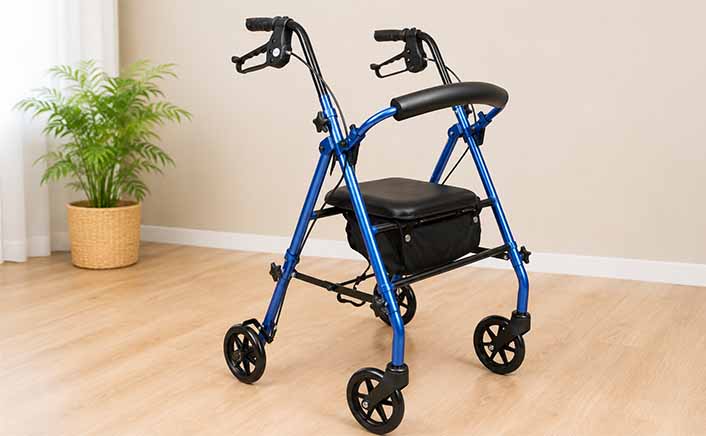
One of the primary factors driving market expansion is the increasing adoption of rollators (wheeled walkers), which currently represent the leading product type within the market with a major share. Rollators offer superior maneuverability, integrated seating for rest breaks, built-in storage compartments, and hand-operated braking systems that provide greater control and safety compared to standard walkers. These advantages make rollators particularly suitable for elderly users and post-surgical patients seeking to maintain an active outdoor lifestyle. Continuous technological improvements and growing preference for wheeled mobility solutions continue to reinforce the dominance of rollators across both developed and emerging markets.
Despite its strong growth outlook, the industry continues to face several challenges. Inconsistent insurance reimbursement policies and high out-of-pocket costs for advanced feature-rich models limit adoption among price-sensitive consumers. Premium rollators equipped with electronic braking systems, GPS tracking, or fall-detection sensors remain relatively expensive, particularly in emerging economies where healthcare spending on assistive devices is comparatively low. In addition, residual social stigma associated with using mobility aids continues to affect adoption among certain user groups.
North America continues to dominate the Global Walkers and Rollators Market, accounting for a major share of 38.4% in 2025, owing to advanced healthcare infrastructure, high healthcare expenditure, strong reimbursement coverage under Medicare and private insurance, and the strong presence of leading manufacturers involved in mobility aid research and commercial development. Europe maintains a significant market position with a 27.8% share, supported by a rapidly aging population, well-established elderly care systems, and favorable government support for assistive devices. Meanwhile, Asia-Pacific, holding 22.5% share, is expected to witness the fastest growth during the forecast period, supported by a large and expanding geriatric population, rising healthcare awareness, and improving healthcare infrastructure. Latin America and the Middle East & Africa are gradually strengthening their positions through improving healthcare access, rising awareness of mobility aids, and growing investments in elderly care and rehabilitation services.
Competitive Landscape
Some of the major companies operating within the Global Walkers and Rollators Market are Invacare Corporation, Drive DeVilbiss Healthcare, GF Health Products, Inc., TOPRO Industri AS, Human Care HC AB, Karman Healthcare, Inc., Compass Health Brands, Benmor Medical Ltd., Evolution Technologies Inc., and others.