Europe Mechanical Press Market Trends Across Automotive, Metal Fabrication, Electrical & Electronics, and Aerospace
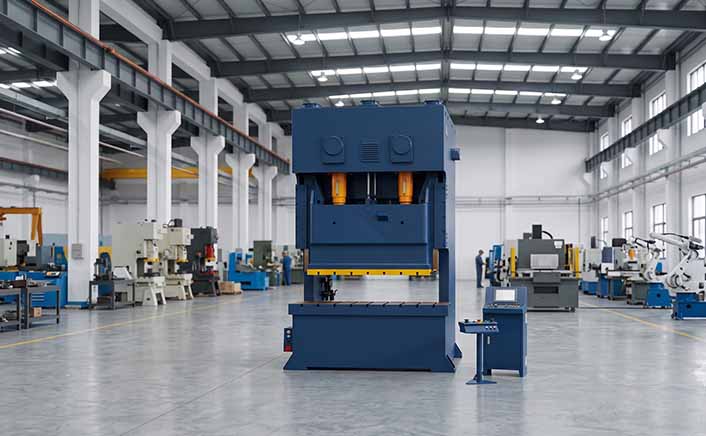
The automotive industry holds a significant position in the European Mechanical Press Market, capturing a 35.4% share. This dominance stems from the industry's reliance on high-volume sheet metal stamping for various components such as body panels, chassis assemblies, suspension parts, seat structures, cross members, battery enclosures, and various structural reinforcements. The production of vehicles in Europe increasingly depends on automated press lines that can handle advanced high-strength steel (AHSS), ultra-high-strength steel (UHSS), aluminum alloys, and galvanized sheet materials with a high degree of repeatability. Key manufacturing hubs located in Germany, Spain, France, Italy, Poland, Slovakia, and the Czech Republic continue to invest in new stamping lines designed to support electric vehicle platforms and lightweight vehicle designs. The rise of localized manufacturing for EV battery enclosures has further boosted the demand for medium- and high-capacity mechanical presses, which are essential for maintaining dimensional accuracy in large-scale production. The automotive sector remains the largest market for replacement equipment, as manufacturers seek to modernize aging stamping machines by adopting digitally monitored, servo-fed production lines that enhance throughput and minimize downtime.
In the metal fabrication sector, which accounts for 15.2% of total demand, there is a diverse customer base. Unlike automotive production, metal fabrication companies tend to work with smaller production batches, creating items such as fabricated enclosures, cabinets, brackets, industrial housings, storage systems, agricultural components, architectural products, and custom-engineered metal parts. As a result, demand is primarily focused on versatile mechanical presses in the 101–300-ton and 301–600-ton range, which facilitate rapid die changes and multi-product manufacturing. The growth of precision sheet metal fabrication, particularly in support of renewable energy equipment, electrical infrastructure, and industrial automation, presents additional opportunities for mechanical press suppliers in Central and Eastern Europe.
The industrial machinery segment contributes 10.8% to the market, driven by the need for machine frames, conveyor systems, pumps, compressors, agricultural machinery, mining equipment, and factory automation systems. Mechanical presses are widely utilized for forming heavy-duty steel components that require consistent dimensional tolerances over prolonged production runs. The increasing focus on Industry 4.0 manufacturing has spurred investment in replacing older mechanical presses with advanced automated systems that include electronic stroke monitoring, predictive maintenance software, and robotic material handling.
The electrical and electronics industry represents 9.1% of market demand, largely due to the large-scale production of motor laminations, electrical cabinets, switchgear enclosures, transformers, connectors, busbars, and precision electronic components. The growth of electric mobility has substantially increased the need for stator and rotor laminations, necessitating high-speed mechanical presses that can operate at several hundred strokes per minute to meet productivity targets while ensuring tight dimensional tolerances. In this segment, progressive die technology has gained importance for its capability to manufacture complex precision components while minimizing material waste.
The appliances industry accounts for 7.4% of total demand, supported by steady production rates of refrigerators, washing machines, ovens, dishwashers, air-conditioning equipment, and commercial kitchen systems across Europe. Manufacturers are leaning towards flexible stamping systems that can accommodate multiple product models while reducing setup times. There is particularly strong demand for medium-capacity presses used to produce exterior panels, internal structural frames, compressor housings, and ventilation assemblies. The growing preference for energy-efficient household appliances has driven manufacturers to invest in automated press lines that enhance consistency while lowering manufacturing costs.
In the aerospace and defense sector, which constitutes 6.2% of market demand, the focus is on producing precision-formed components made from aluminum, titanium, and high-strength alloys, all manufactured to very tight dimensional tolerances. Unlike the automotive industry, aerospace production prioritizes component quality over speed, leading to a higher demand for high-rigidity straight-side presses, precision tooling, and digitally monitored forming systems. Additionally, increased defense spending across Europe is fostering investment in manufacturing equipment suited for military aircraft, missile systems, armored vehicles, and specialized defense components.
The packaging industry accounts for 4.3% of the market, predominantly through the production of metal cans, closures, food containers, aerosol components, and industrial packaging products. High-speed mechanical presses are essential in this sector as they support continuous production with short cycle times and consistent product quality. Furthermore, the construction equipment industry, which comprises 3.8% of the market, relies on medium- and high-capacity presses for the production of structural brackets, loader components, excavator assemblies, and other related items.