Component Analysis Reveals the Fastest-Growing Opportunities in the Global Direct Methanol Fuel Cells (DMFC) Market
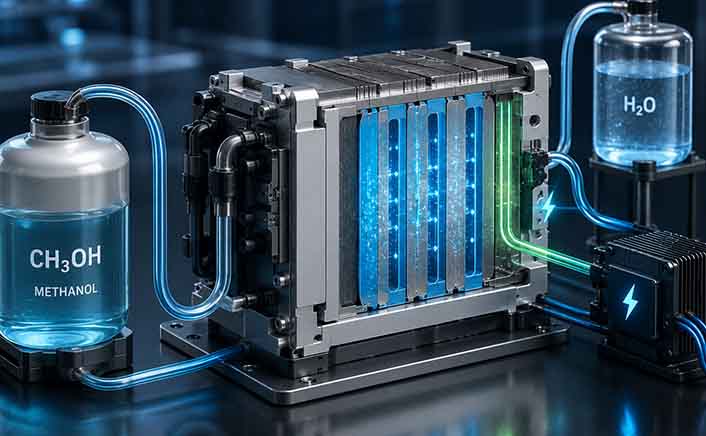
The Membrane Electrode Assembly (MEA) commands the largest 21.5% share of the Global Direct Methanol Fuel Cells (DMFC) Market because it serves as the electrochemical core where methanol oxidation and electricity generation occur.
Performance improvements in proton exchange membranes, catalyst utilization, and electrode architecture have significantly enhanced power density and fuel efficiency, making the MEA the highest-value component within every DMFC system. The Catalyst Layer, accounting for 14.2%, represents the second-largest share due to the use of platinum-ruthenium catalysts that facilitate methanol oxidation while minimizing catalyst poisoning. Continuous research into reducing precious metal loading without compromising efficiency has become a major focus for manufacturers seeking lower production costs and improved commercial competitiveness. Bipolar Plates, with 11.8%, remain essential for current distribution, reactant flow management, and structural integrity. Increasing adoption of lightweight graphite composites and corrosion-resistant metallic plates is reducing system weight while improving durability for defense and industrial applications.
The Fuel Delivery System, representing 8.6%, has become increasingly sophisticated through the integration of precision micro-pumps, flow regulators, and automated cartridge management technologies that ensure stable methanol supply under varying operating conditions. This is particularly important in portable military equipment and unattended industrial installations where uninterrupted fuel delivery directly influences runtime. Thermal Management Systems account for 7.5%, reflecting growing emphasis on maintaining optimal operating temperatures to maximize electrochemical efficiency and extend membrane life. Modern compact heat exchangers and intelligent temperature control systems have enabled more reliable operation across harsh environmental conditions, including deserts, offshore platforms, and high-altitude deployments.
The Gas Diffusion Layer (6.9%) continues to gain technological importance by improving reactant distribution while efficiently removing carbon dioxide generated during methanol oxidation. Advances in porous carbon materials and hydrophobic coatings have enhanced gas transport characteristics and minimized flooding, resulting in more stable long-duration performance. The Power Conditioning Unit, holding 6.2%, has become increasingly valuable as DMFC systems are integrated with lithium-ion batteries, supercapacitors, communication equipment, and industrial electronics. Advanced DC-DC converters and intelligent power management circuits optimize voltage stability, improve load response, and increase overall system efficiency for sensitive electronic devices.
The Fuel Tank, accounting for 5.8%, has evolved beyond simple storage vessels into engineered modules designed for safe methanol containment, rapid cartridge replacement, leak prevention, and compliance with transportation regulations. Growing adoption of standardized fuel cartridges has improved operational convenience across defense logistics, field service operations, and remote monitoring infrastructure.
Sensors & Controllers, representing 4.9%, play an increasingly critical role by continuously monitoring temperature, fuel concentration, pressure, voltage, and system health. Integration of embedded diagnostics and predictive maintenance algorithms enables operators to detect performance deviations before failures occur, reducing maintenance requirements and improving system availability.
Current Collectors, with 3.8%, remain indispensable for minimizing electrical resistance and ensuring uniform current distribution across the fuel cell stack. Manufacturers increasingly employ corrosion-resistant conductive materials that maintain electrical performance under prolonged methanol exposure while reducing contact losses during extended operating cycles. Although these components contribute a smaller percentage of total system cost, their influence on electrical efficiency and stack reliability remains substantial.
Among service-oriented segments, System Integration Services account for 3.3%, reflecting increasing demand for customized integration of DMFC systems into telecom infrastructure, military communication equipment, autonomous vehicles, industrial automation platforms, and hybrid renewable energy systems. Engineering expertise is becoming increasingly valuable as customers require application-specific configurations rather than standardized products. Replacement Components, contributing 2.4%, are supported by periodic replacement of membranes, catalysts, seals, and electronic modules as operational hours accumulate. Growth in this segment reflects the gradual expansion of the installed base rather than initial equipment sales.
Maintenance Services, representing 1.9%, remain comparatively small because DMFC systems contain fewer moving parts than conventional combustion generators and therefore require less routine servicing. However, scheduled inspections, software diagnostics, calibration, and preventive maintenance continue to support long-term operational reliability, particularly in mission-critical defense, telecom, and industrial installations. The Air Supply System, accounting for 1.2%, represents the smallest component segment since passive air-breathing designs are increasingly used in compact and portable DMFC configurations, reducing mechanical complexity and manufacturing costs. Active airflow management remains relevant primarily in higher-output systems where optimized oxygen delivery directly influences efficiency.
Overall, the component structure of the Global Direct Methanol Fuel Cells (DMFC) Market demonstrates that value creation is concentrated within electrochemical technologies—including MEAs, catalysts, and bipolar plates—while supporting subsystems increasingly differentiate products through improved efficiency, intelligent monitoring, compact integration, and extended operational life. Future innovation is expected to focus on reducing precious metal dependency, increasing membrane durability, miniaturizing electronic control systems, and developing standardized modular architectures that lower manufacturing costs while expanding adoption across defense, telecommunications, industrial monitoring, healthcare, and remote power applications.