Global Air Traffic Management Market by Component: How ATC Systems, Software, and Surveillance Technologies Are Transforming Aviation
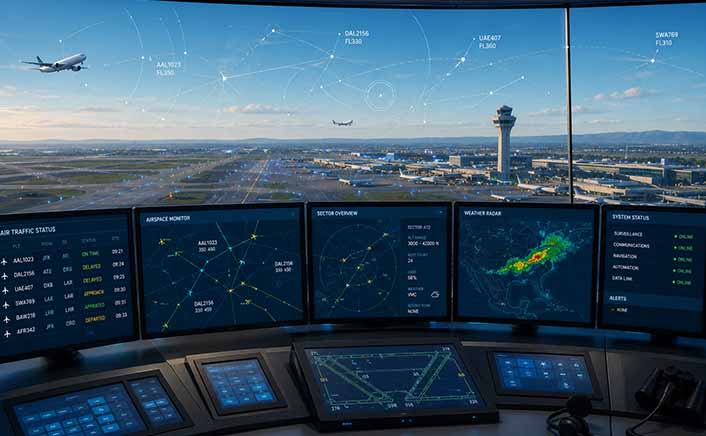
The Air Traffic Control (ATC) Systems segment dominates the Global Air Traffic Management Market with approximately 14.2% share, as ATC infrastructure remains the operational backbone of global aviation networks. Airports and air navigation service providers (ANSPs) continue investing in modernization of control centers, tower systems, and approach control platforms to manage increasing aircraft movements and improve airspace efficiency. Replacement of aging ATC infrastructure under programs such as FAA NextGen in the United States and SESAR in Europe is accelerating demand for integrated control solutions that combine communication, navigation, surveillance, and automation capabilities.
The Communication Systems segment accounts for 11.6% market share, supported by the critical role of reliable aircraft-controller communication in maintaining safe flight operations. Traditional Very High Frequency (VHF) communication continues to have widespread deployment; however, the market is shifting toward advanced communication platforms including satellite communication (SATCOM), Controller-Pilot Data Link Communications (CPDLC), and digital voice communication systems. Increasing air traffic density, expansion of remote airspace monitoring, and demand for uninterrupted communication coverage are encouraging aviation authorities to upgrade communication infrastructure.
Surveillance Systems represent the third-largest component category with 10.8% share, driven by the aviation industry's transition toward accurate, real-time aircraft tracking. Modern ATM networks increasingly rely on advanced surveillance technologies such as ADS-B, multilateration, and space-based surveillance to enhance aircraft visibility beyond traditional radar coverage. ADS-B adoption has become particularly important because it provides more frequent aircraft position updates and improves surveillance efficiency across congested and remote airspaces. The expansion of satellite-enabled surveillance is expected to further strengthen this segment by improving monitoring capabilities over oceanic and underserved regions.
The Air Traffic Management Software segment captures 9.7% share and is becoming increasingly important as aviation systems move toward digital and automated operations. Software platforms enable integration of flight information, traffic prediction, airspace management, and operational decision-making. Modern ATM software solutions are replacing isolated legacy systems with centralized platforms capable of processing large volumes of aviation data. Demand is increasing for software that supports collaborative decision-making between airports, airlines, and ANSPs to reduce delays and optimize aircraft movements.
Radar Systems account for 8.9% of the market, maintaining strong demand due to their proven reliability in aircraft detection and tracking. Primary Surveillance Radar (PSR) and Secondary Surveillance Radar (SSR) remain essential technologies, particularly at major airports and high-density airspaces. While newer satellite-based surveillance technologies are expanding, radar continues to serve as a critical backup and complementary system due to its operational maturity and ability to support continuous monitoring.
The ADS-B Systems segment contributes 7.8% share, supported by regulatory mandates and modernization initiatives worldwide. ADS-B enables aircraft to transmit precise location information using satellite navigation, allowing controllers to achieve improved traffic awareness while reducing dependence on traditional radar infrastructure. Adoption is increasing across commercial aviation, general aviation, and unmanned aircraft operations, making ADS-B a key technology for future integrated airspace management.
Navigation Systems hold 7.4% share, driven by increasing adoption of satellite-based navigation and performance-based navigation (PBN). GNSS-enabled systems are improving route efficiency by allowing aircraft to follow optimized flight paths, reducing fuel consumption and emissions. Airlines and aviation authorities are increasingly implementing PBN procedures to improve airport approach capabilities and increase airspace capacity without requiring extensive physical infrastructure expansion.
Data Processing Systems represent 5.9% share, reflecting growing requirements for real-time processing of flight, surveillance, and operational information. These systems support the integration of multiple ATM data sources, enabling controllers and aviation operators to make faster and more informed decisions. As aviation ecosystems become increasingly connected, demand for high-performance data processing infrastructure is expected to increase.
Flight Data Processing Systems (FDPS) account for 4.8% share, supporting automated processing and management of flight plans, aircraft trajectories, and operational information. FDPS solutions are becoming more sophisticated with the integration of AI-based prediction models and advanced automation features that help optimize aircraft sequencing and reduce controller workload.
The Air Traffic Flow Management (ATFM) Software segment captures 4.3% share and is gaining importance due to increasing airspace congestion. ATFM platforms help balance aircraft demand with available airport and airspace capacity by optimizing departure slots, routes, and traffic flows.
These systems are becoming essential as airports experience higher passenger volumes and increasing aircraft movements.
Remote Tower Systems represent 3.8% share and are among the fastest-growing components within the ATM ecosystem. Digital towers equipped with high-resolution cameras, sensors, and advanced analytics enable centralized air traffic management for multiple airports. These systems provide opportunities for regional airports to maintain efficient air traffic services while reducing infrastructure and operational costs.
Weather Monitoring Systems contribute 2.9% share, supported by increasing demand for accurate weather intelligence to improve flight safety and operational planning. Advanced weather systems integrated with ATM platforms help reduce weather-related delays by providing predictive information on storms, visibility conditions, and turbulence.
Emerging software-driven segments such as Decision Support Systems (2.5%), Surveillance Data Processing Systems (2.3%), Conflict Detection & Resolution Software (1.6%), and Artificial Intelligence-Based ATM Software (1.0%) currently represent smaller market shares but are expected to experience strong growth. AI-based ATM software is gaining attention for applications including predictive traffic management, automated conflict resolution, controller assistance, and airspace optimization.
Overall, the Global Air Traffic Management Market is transitioning from hardware-intensive infrastructure toward integrated digital ecosystems combining surveillance, automation, AI, cloud computing, and advanced analytics. While ATC, communication, and surveillance systems continue to generate the majority of current revenue, future market expansion will increasingly be driven by intelligent ATM software, remote towers, AI-powered decision systems, and automated airspace management technologies.