The Rise of Smart Luggage: Why Travelers Are Paying More for Peace of Mind
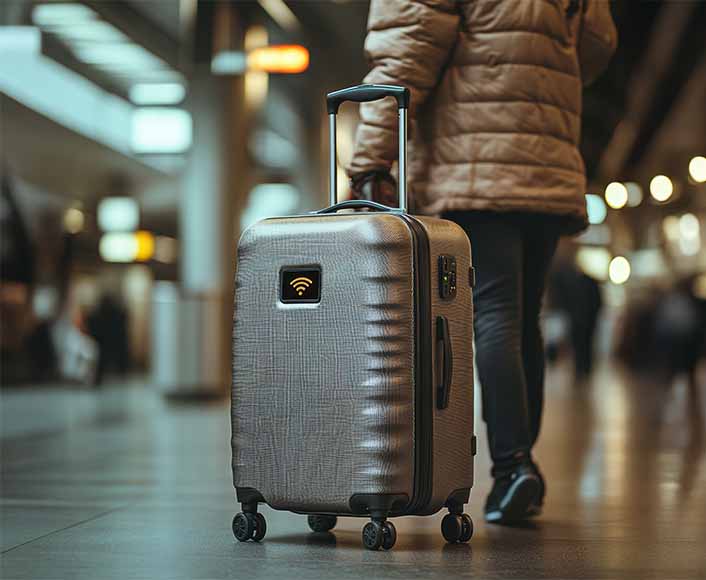
Every frequent traveler has a story about lost luggage.
Maybe your suitcase disappeared somewhere between New York and Chicago. Maybe it arrived three days late in another country. Maybe you've stood at baggage claim, refreshing the airline app every thirty seconds, while convincing yourself the next bag on the carousel would finally be yours.
For millions of travelers, airport uncertainty has become part of the journey. Smart luggage wasn't created because people wanted another gadget. It emerged because travel has become increasingly stressful, and consumers are willing to pay for products that reduce even a small amount of that friction.
That shift is transforming smart luggage from a niche travel accessory into one of the fastest-growing premium categories in the luggage industry.
What Smart Actually Means Here
Not AI. Not sentient. Just: a GPS chip that tells your phone where the bag is. A USB port that charges your dying phone mid-layover. The TSA digital lock opens without damaging the zipper. A weight sensor so you don't get hit with a $75 fee at check-in for packing one too many Sephora hauls.
That's it. That's the pitch. And it's working.
U.S. Smart Luggage Market was valued at $810 million in 2025. Heading to $1.96 billion by 2033 — nearly 12% CAGR. Not because people suddenly love technology. Because airport chaos is a universal human experience, someone finally came up with a solution. TSA processed over 904 million passengers in 2024 alone. That's 904 million opportunities for something to go wrong and 904 million reasons someone might consider upgrading their luggage.
The Battery War Nobody Warned You About
Most discussions about smart luggage skip the industry's biggest turning point.
In 2018, several airlines began restricting or banning checked smart luggage equipped with non-removable lithium-ion batteries. Safety concerns surrounding battery fires forced regulators and airlines to tighten their policies, catching many manufacturers unprepared.
For brands whose products relied on permanently installed batteries, the impact was immediate. Retailers returned inventory, product launches stalled, and entire business models suddenly became obsolete.
The companies that survived did something more important than adding new features—they redesigned their products around regulation.
Today, removable battery packs have become the industry standard. Before checking a bag, travelers remove the battery and carry it onboard, satisfying airline safety requirements without sacrificing functionality.
Rather than slowing innovation, regulatory pressure forced manufacturers to build better, more practical products. It also separated companies focused on engineering from those simply chasing a trend.
Who's Actually Buying This
Not your uncle with the 1997 Samsonite that's still perfectly fine.
Urban professionals. Millennials. Frequent flyers who board more than 25 flights a year and have opinions about TSA PreCheck lane etiquette. The "bleisure" crowd is people who extend a Tuesday conference in Austin into a long weekend in the Hill Country because remote work made that possible.
These consumers don't shop for luggage like a commodity. They compare battery specs, check Apple Find My compatibility, and read Reddit threads about hinge durability. They're buying a travel system, not a bag.
Average smart luggage price: $250–$700. Standard luggage: $80–150. The gap is real. Willingness to pay depends entirely on how much you've suffered at baggage claim.
The AirTag Problem
Uncomfortable truth: Apple AirTag costs $29. Slips into any bag pocket. Tracks location. Works.
This is the competitor nobody in the smart luggage industry loves talking about. Standalone trackers, portable power banks — they do 70% of what smart luggage does, cheaper, without battery compliance headaches.
So why does smart luggage still grow?
Consolidation. One bag, no accessories to lose, premium aesthetics, durability-grade build. Business travelers on T&E budgets don't want to carry three separate gadgets. They want one thing that works. And companies are quietly restoring corporate travel budgets post-pandemic: conferences, consulting road trips, sales cycles. That spending flows toward premium categories.
There's also a design argument. Away didn't grow by out-teching the competition. It grew by making smart luggage look good, with clean lines, minimal branding, and Instagram-ready colorways. Rimowa does it at luxury price points. When a bag functions as much as a lifestyle signal as a utility product, the $29 AirTag stuffed in a discount roller isn't really the same purchase decision.
What's Driving the Next Phase of Innovation?
The industry's next chapter won't be defined by adding more gadgets. It will be defined by making existing technology nearly invisible.
Several trends are already shaping that evolution:
- Fingerprint authentication is replacing traditional combination locks.
- USB-C is becoming the universal charging standard.
- Lightweight recycled polycarbonate shells support sustainability goals.
- Integrated weight sensors are becoming standard across mid-range products.
- Better connectivity with travel ecosystems through platforms like Apple Find My.
The objective isn't to impress travelers with technology.
It's to eliminate moments of uncertainty.
When your suitcase arrives exactly where it should, charges your phone during a delay, stays within airline weight limits, and requires almost no attention, the technology has done its job.
The Real Product Isn't the Suitcase
At first glance, smart luggage looks like another premium travel accessory.
In reality, it's selling something much less tangible.
It sells confidence.
Confidence that your luggage hasn't disappeared into an airport somewhere. Confidence that your phone won't die before boarding. Confidence that you won't discover you're five pounds overweight at the check-in counter.
The technology itself isn't the product.
Reducing travel anxiety is.
As airports become busier, business travel rebounds, and consumers continue to prioritize convenience over ownership costs, that value proposition becomes increasingly compelling.
The smartest luggage isn't trying to change how people travel.
It's trying to make travelers think about their luggage a little less. And for an industry built around removing friction, that's probably the smartest innovation of all.