Green Hydrogen's Make-or-Break Decade: Why Production Breakthroughs Won't Matter Without Infrastructure
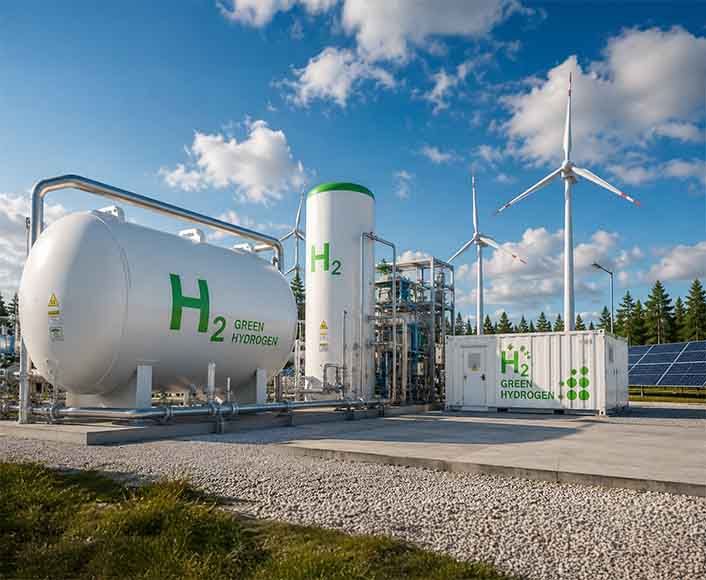
Green Hydrogen has been the perpetual "next big thing" in energy transition conversations for a decade. But that status is starting to shift. Investment is flowing, giga-projects are breaking ground, and the technology stack underpinning production has diversified well beyond the electrolysis-or-nothing framing that dominated early coverage. However, a market's technical and commercial maturity are two different stories, and the gap between them in green hydrogen is where the real narrative sits right now.
Beyond Electrolysis: The Production Landscape Is Getting Crowded
For years, "green hydrogen" was shorthand for one process: splitting water with renewable electricity via electrolysis. That's still the dominant pathway, but it's no longer the only one attracting serious investment. Steam methane reforming paired with carbon capture, thermochemical water splitting, biomass gasification, and photoelectrochemical splitting are all being evaluated at commercial scale, each with distinct cost curves, feedstock dependencies, and regional suitability. Our Green Hydrogen Market breaks down how these methods stack up against each other by application and storage distribution through 2030. The answer isn't as electrolysis-dominant as most headlines suggest. Different regions are placing different bets based on the feedstocks and renewable capacity they have on hand, which means the "one true pathway" narrative is already outdated.
Diversification matters because it changes who can realistically compete. A market defined solely by electrolysis favors regions with cheap, abundant renewable power. A market that also rewards biomass gasification or thermochemical routes opens the door to countries with different natural endowments: arid, sun-rich nations without wind resources, or agricultural economies with abundant biomass feedstock but limited grid capacity. This is a more interesting and more investable market than the one most coverage still describes, and it's one where technology choice is becoming as important a differentiator as raw production volume.
Why Storage and Application Segments Deserve More Attention
Production method is only half the equation. How that hydrogen is stored and where it is ultimately used, whether in mobility, as an industrial feedstock, for power generation, or exported as a carrier fuel, shapes a project's economics long before the first molecule is produced. Storage and distribution, in particular, are becoming strategic variables rather than afterthoughts, since the choice among compressed gas, liquid hydrogen, or conversion to ammonia determines transport costs, infrastructure needs, and which export markets are even reachable. Producers who lock in storage and application strategy early are the ones building bankable projects; those who treat it as a downstream detail are the ones stuck with stranded capacity.
Saudi Arabia: The Clearest Proof Point for Export-Driven Growth
If you want to see what aggressive, capital-backed green hydrogen deployment looks like in practice, Saudi Arabia is the case study. The country is positioning itself as an export powerhouse, not a domestic-consumption story. Most of the hydrogen produced in Saudi Arabia is converted into green ammonia and shipped to Europe and Asia, where decarbonization mandates are driving durable demand. Our Saudi Arabia Green Hydrogen Market explains how projects like NEOM are anchoring the Western Region as a giga-scale production hub, why PEM electrolysis is emerging as the fastest-growing technology segment there, and how the market's B2B, long-term-offtake structure differs sharply from more consumer-facing energy markets.
What's notable is how little this market depends on domestic uptake. Refining and petrochemicals are the earliest domestic adopters, but they're a secondary story compared with the export thesis. That's a structurally different growth model from what greenfield hydrogen economies in Europe or Southeast Asia are pursuing, and it's a useful lens for understanding why "green hydrogen demand" numbers vary so wildly depending on which region's report you're reading. A market driven by multi-year offtake agreements with international buyers behaves nothing like one waiting for consumer or fleet adoption to materialize.
The Infrastructure Gap Nobody Wants to Talk About
Here's the uncomfortable part. Production capacity and export ambition mean very little if the infrastructure to move, store, and dispense hydrogen doesn't scale alongside them. Fueling infrastructure, in particular, remains a bottleneck, especially outside the handful of markets where governments have made refueling networks a policy priority. Our Hydrogen Fueling Stations Market tracks this gap directly: small-format stations still dominate; Europe is growing fastest, largely due to regulatory pushes such as the EU's Alternative Fuels Infrastructure Regulation; and the upfront capital cost of new stations remains one of the biggest constraints on market expansion.
This is the piece that often gets lost in production-focused hydrogen coverage. A country can meet every electrolysis capacity target on its roadmap and still fail to build a hydrogen economy if there's nowhere for that hydrogen to go once it's produced. Infrastructure isn't a footnote to the green hydrogen story; it's arguably the rate-limiting step for anyone outside the export-driven, ammonia-shipping model pursued by Saudi Arabia and similar producers. Mobility and transport applications, in particular, will remain capped until refueling density crosses a usability threshold, regardless of how cheap production becomes.
What This Means Going into the Back Half of the Decade
Put these three pieces together, and a clearer picture emerges. Production technology is diversifying in ways that widen the field of viable producers. A handful of capital-rich, resource-advantaged regions are already proving the export-driven model works. And infrastructure, quiet, unglamorous, capital-intensive infrastructure, is the variable that will determine whether green hydrogen becomes a genuine multi-region energy transition story or stays concentrated in a small number of giga-project hubs.
For companies, investors, and policymakers trying to figure out where to place bets, the questions worth asking aren't "Will green hydrogen work?” That's largely settled.
The main question remains: which production pathway fits your regional resource base, what does your offtake and export strategy actually look like, and is there a credible plan to address the infrastructure gap before capacity comes online? Markets that can answer all three will pull ahead. Markets that answer only one or two will keep showing up in headlines, but not in deployment numbers.