Why South Korea's Apartments Are Rewriting the EV Charging Playbook
Seoul has one of the densest concentrations of high-rise apartment living in the developed world. That single fact of urban geography, not battery chemistry or government subsidy, is quietly becoming one of the most important variables in how South Korea battery electrifies its vehicle fleet.
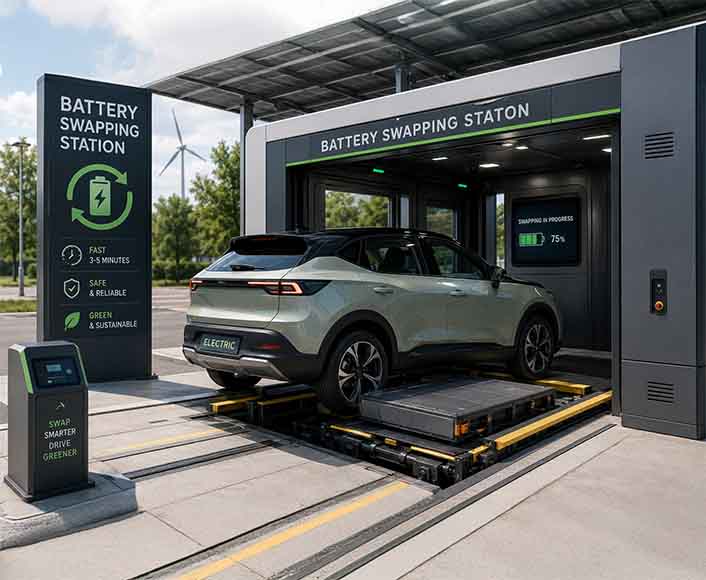
Most conversations about EV infrastructure default to a simple assumption: more chargers solve the problem. Install enough Level 2 units in enough parking garages, and adoption will follow. South Korea is a useful case study showing why that assumption breaks down in dense, vertical cities and why an alternative model, battery swapping, is gaining real commercial traction as a result.
How Apartment-Dominant Housing Creates South Korea's EV Charging Bottleneck
Roughly six in ten South Korean households live in apartment complexes. In Seoul, Incheon, and Busan, the housing stock is dominated by high-rises with shared, association-managed parking. A homeowner with a driveway can install a charger in an afternoon. An apartment resident must navigate the building association's approval process, shared electrical capacity limits, and competition with neighbors for a limited number of charging bays.
This isn't a temporary bottleneck that resolves as EV adoption climbs — it gets worse. Each additional EV in a building competes for the same fixed electrical infrastructure. Retrofitting older complexes requires transformer upgrades and parking reconfigurations that lag behind fleet growth. The result is a structural mismatch: charging demand scales with vehicle adoption, but charging supply is capped by building-level constraints that don't scale.
Why Battery Swapping Solves a Problem Plug-In Charging Structurally Can't
Battery swapping sidesteps the apartment bottleneck entirely by decoupling energy access from residential parking. Instead of waiting overnight for a charger that may not be available, a driver swaps a depleted battery for a charged one at a centralized station in minutes.
The economics favor this model precisely where land is expensive, and density is high. A single, centrally located swapping station can serve a customer base that would otherwise require installing chargers across dozens of individual buildings. That's a meaningfully different capital allocation problem — and one that scales more efficiently in cities where every square meter of real estate carries a premium.
Why Delivery Riders — Not Passenger Car Owners — Are Driving Current Demand
The segment leading this market isn't private passenger vehicles — it's electric two-wheelers, which account for roughly half of total swapping revenue. That's a direct function of South Korea's delivery economy. Courier and food-delivery riders in Seoul and Busan operate on tight turnaround windows, where charging downtime directly hits earnings. For platform-based delivery operators, a 90-second battery swap versus a 30-minute charge isn’t convenient; it's a productivity variable that shows up in rider throughput.
Light commercial vehicles follow a similar logic. As e-commerce logistics networks expand and electrify fleets, operators are evaluating swapping not as a novelty but as a way to keep vehicles in service longer per shift. Passenger EVs remain a smaller share of swapping demand for now, still anchored to conventional home and public charging — but that's expected to shift as battery standardization matures.
What Battery Standardization Means for Investors Watching This Market
Swapping's biggest structural challenge isn't technology; it's coordination. The model only scales efficiently if battery formats are interchangeable across vehicle brands and manufacturers. Right now, the companies active in this space span battery makers, automakers, and mobility platforms, each with its own commercial incentives regarding proprietary versus shared battery architecture.
That tension between automakers seeking differentiated battery systems and swapping operators needing standardized ones is the key variable determining how quickly this market scales beyond two-wheelers into passenger cars and trucks. Watching who moves toward battery-as-a-service partnerships versus who stays vertically integrated will tell you more about the market's trajectory than any adoption forecast.
Where Growth Goes Next: Autonomous Delivery and Fixed-Route Fleets
Autonomous delivery robots and unmanned logistics platforms are emerging as the fastest-growing category in this space, which says something about where urban mobility infrastructure is heading: toward systems designed for continuous, unattended operation rather than human-scheduled charging stops. Electric buses, with their need for fast turnaround on fixed routes, represent another segment where swapping's speed advantage over charging is structurally, not just economically, favorable.
What South Korea's Model Signals for Other Dense Urban Markets
South Korea's battery-swapping market isn't succeeding because it's a superior technology in the abstract. It's succeeding because it's a better fit for a specific urban housing reality that plug-in charging infrastructure struggles to meet. That distinction matters for any market watching this model as a bellwether. Cities with similar density and apartment-dominant housing stock, across parts of Asia and, increasingly, the Middle East, are most likely to see swapping gain traction. Businesses positioning themselves early in battery standardization and station network density are best placed to capture what comes next.